The Goddess and the Great Perfection: Exploring Ekajati’s role in Dzogchen
Sam van Schaik
Ekajati and Dzogchen
Namkhai Norbu’s The Crystal and the Way of Light is a classic modern work that helped introduce and popularise Dzogchen to Western audiences. Mixing autobiographical reminiscences with key concepts of Dzogchen, it is a very accessible book. Though it has since been joined by many more books introducing Dzogchen to the general reader, The Crystal and the Way of Light remains one of the most engaging in its mixture of autobiography, history, and exposition.[1] In this and later books, Namkhai Norbu has been keen to show the embeddedness of Dzogchen in the Tibetan cultural contexts; one example of this is the role of the wrathful goddess Ekajati in transmitting and protecting the Dzogchen teachings:
Ekajati, whose name means ‘One Single Birth,’ is the principal Guardian of the Dzogchen teachings. She manifests with one single eye, one single tooth, one single tuft of hair, and one single breast. A personification of the essentially non-dual nature of primordial energy, she does not allow duality to develop.[2]
The book also gives a reason for Ekajati having this special role.[3] While the protectors of the Mahakala class are often dominant in other contexts, they are male, while “only the Dzogchen teachings, in which the feminine principle of energy is of such prime importance, have a feminine protector, Ekajati, as the principal Guardian.”[4] Visually Ekajati is a deity who seems to embody Dzogchen. In the form in which she is often supplicated in the Nyingma tradition, she has one braid of hair (which is also the literal translation of her name), and also one eye, one fanged tooth, and a single breast. These features powerfully evoke the nonduality that is so important in the Dzogchen teachings. Like the naked Samantabhadra, and the depictions of Padmasambhava clad in rainbows, Ekajati is a visual paradigm for Dzogchen itself.
Even a quick look at the biographical literature of the Nyingma tradition, and the Dzogchen teaching lineages in particular, shows us why this wrathful deity was given such a prominent place in an introductory book on Dzogchen. While she is worshipped as a dharma protector across Nyingma traditions, it is in the Nyingthik (snying thig, heart essence) lineages of Dzogchen that she has taken on a more visionary role.[5] In accounts of the visionary experiences that lead to the revelation of Dzogchen texts to treasure revealers, or tertön (gter ston), Ekajati appears again and again. The earliest surviving history of the Nyingthik lineage, written in the twelfth century by Shangtön Tashi Dorjé (zhang ston bkra shis rdo rje, 1097–1167), gives Ekajati a foundational role in the transmission of the teachings. The history tells of how the Indian teacher Shri Singha codified and arranged the Nyingthik texts, and then had a dream in which a goddess instructed him to go to the temple of the Auspicious Threefold Gate in China and conceal the teachings there. Shri Singha did so, placing the texts in a pillar, and entrusting them to the dakinis and dharma protectors, and in particular, to Ekajati, who treated him like a son.[6]
Ekajati also features in the biography of Longchenpa (klong chen rab ’byams, 1308–1363), as the first among many female deities who manifested during an important teaching of the Dzogchen Nyingthik to a group of disciples.[7] A long passage in the biography describes how, during empowerments related to transmitting these teachings, Longchenpa’s female students were possessed by goddesses, starting with Ekajati, who gave him instructions on how to proceed:
When he conferred the blessing of the elaborate empowerment one yogini was possessed by Ekajaṭī the protectress of mantra; and she began to dance. The other disciples could not bear her radiance, but the guru said, “You need not worry because she is possessed by a ḍākinī. As I am a yogin who has realised that mind and appearances are of the same savour, no obstacles will come of it.”[8]
Ekajati proceeds to instruct, and reprimand in a suitably wrathful fashion, Longchenpa as he carries out the tantric feast empowerment. Presiding over the actual empowerment, she sings a song of realisation that includes the words:
Mind free from meditation is joyful.
Mind free from meditation—Oh my! It is happy.[9]
Then when the empowerment nectar is offered to Longchenpa, she encourages him to drink it all, rather than the usual practice of just taking a sip before it is circulated among the other participants.
Unsurprisingly, Ekajati is also present in the visionary experiences of Jigme Lingpa (’jigs med gling pa, 1730–1798), the revealer of the Longchen Nyingthik treasure cycle. Janet Gyatso considers her the most significant of the many female deities and ḍākinīs who bestow visions and prophecies on Jigme Lingpa, calling her “Jigme Lingpa’s heroine in the secret autobiographies.”[10] Other biographical sources further fill out this sense of Ekajati’s key role in the Nyingma tradition in general and the transmission of the Dzogchen Nyingthik in particular. The above-mentioned Shangtön Tashi Dorjé is said to have been guided by Ekajati in his practice and the dissemination of the Dzogchen teachings. The following account occurs in the context of Shangtön being guided by the protector Dorjé Lekpa to a place of power:
For a moment Zhangton heard a harsh piercing sound. When Dorjé Lekpa explained that it was the voice of his sister, Ekajati, she herself appeared, fearful to behold with her single eye boiling with blood, and her gnashing fangs. “She has given an oracle that you must undertake one hundred and eight feast offerings, and not teach anyone for three years.” Zhangton arranged for the one hundred and eight offerings by selling two turquoise stones which he found in the grass door of the cave.[11]
Another key figure in the Nyingthik tradition was Longchenpa’s teacher Kumaradza (ku mA ra dza, 1266–1363). The following account of a visitation from Ekajati occurs in the context of his practice of the Dzogchen Nyingthik:
Once, during an empowerment, he saw the four-armed Mahakāla above the guru’s head, and the dark blue Ekajati in front of the door. She appeared twice the size of a man, wielding an impaling stake and holding a she-wolf, while outside the door the witch who served her, whose locks were drenched in blood, drank blood which she held in her cupped hands.[12]
More recently, in the nineteenth and early twentieth centuries, biographies of Chokgyur Lingpa (mchog gyur gling pa, 1829–1870), Jamyang Khyentsé Wangpo (’jam dbyangs mkhyen brtse’i dbang po, 1820–1892) and Jamgön Kongtrul Lodrö Thayé (’jam mgon kong sprul blo gros mtha’ yas, 1813–1899) all attest to the role played by Ekajati in their visionary experiences, and the revelation of Dzogchen terma.[13] Thus we see Ekajati appear in traditional Nyingma histories again and again, especially in an inspirational role, and particularly associated with the transmission of Dzogchen.
Ekajati’s Unusual Origin
While there is no doubt about the importance of Ekajati in these stories, we know little about how Ekajati came to have this role in the Nyingma traditions. In fact, her origins present us with a puzzle that suggests an unusual transmission history—from Tibet to India, and back to Tibet again. Therefore, before we explore her place in early Dzogchen, I will look briefly at how Ekajati appears in the Tibetan canon of translated Indic texts and in Sanskrit sources.[14]
There is a concise Ekajati Tantra in the Kangyur, translated in the late twelfth or early thirteenth century, and twenty-eight texts, mostly sādhanas, dedicated to her in the Tengyur.[15] Most, if not all of the Tengyur texts are also translations from the second period of Buddhist diffusion in Tibet, post-dating both the Dunhuang manuscripts and Ekajati’s earliest appearance in Dzogchen texts. As for sources in Sanskrit, there are four Ekajati sādhanas in the Sādhanamālā (no.126), probably dating from the eleventh century.[16] Based on these texts, Benoytosh Bhattacaryya describes Ekajati as “one of the most powerful goddesses in the Vajrayāna pantheon.”[17] One of the sādhanas in the Sādhanamālā describes three forms of Ekajati, with two, four, and eight arms respectively, and summarises her iconography thus:
All these (three) forms (of Ekajaṭā) are of blue color, have the tiger-skin round their loins, are one-faced and three-eyed, and have brown hair rising upwards on their head. They are short, potbellied, wrathful and stand in the Pratyālīḍha attitude, they have faces distorted with anger; with garlands of heads hanging from their necks, they rest on corpses, are terrible in appearance and bear the image of Aksobhya on the crown. They have youthful bloom and laugh horribly and they should be conceived on the orb of the sun over the double lotus.[18]
In her simplest form with two arms, Ekajati holds a weapon called a kartri in one and a skullcup in the other. In the later Tibetan tradition, especially in the Nyingma terma lineages, a form of Ekajati with one eye and one breast became popular; this both extends the meaning of “one” (eka) in her name, and emphasizes her role in Dzogchen, where nonduality is so important.
While we do not find Ekajati in the earlier Sanskrit sādhana collection, the Sādhanaśataka, this collection does include a wrathful blue form of Tārā known as Mahācīnakrama Tārā, which has identical iconography to Ekajati.[19] The name Mahācīnakrama Tārā can be translated as “Tara from the lineage of Greater China.” This vague geographical term might indicate a Chinese, Tibetan, or Central Asian origin for the deity. Another intriguing reference to an origin outside of India occurs in the colophon of one of the Ekajati sādhanas in the Sādhanamālā, which states that Ekajati was brought to India from Tibet (bhoṭa) by Ārya Nāgārjuna.[20] In India, Ekajati and Blue Tara both were also popular outside of Buddhism, and Gudrun Bühnemann argued that the deity was adopted into Hindu traditions from these Buddhist practices.[21]
Thus Ekajati presents a very interesting case in the transmission of Vajrayana practices across Asia. The sources suggest that the iconography of Ekajati and Mahācīnakrama Tārā originated in the Tibetan or Central Asian area and was exported to India at some point before the eleventh century, where the goddess became equally popular. New practices and variant forms of the goddess developed in India, and by the eleventh century, sādhanas featuring Ekajati were being translated from Sanskrit into Tibetan and adopted by the new schools emerging in Tibet in the eleventh to thirteenth centuries. This would mean that the second diffusion of Buddhism in Tibet effectively reintroduced Ekajati to Tibet, albeit in slightly different forms and now more closely associated with the deity Tara.
Some forms of Ekajati that are now specific to the Nyingma tradition represent a different transmission, one that remained in Tibet and underwent all of its development there. This is especially likely in the case of the earliest dateable appearance of Ekajati in Tibet, found in the manuscripts from Dunhuang Cave 17.[22] These manuscripts derive from a cave sealed in the early eleventh century.[23] As we will see below, the manuscript that is the main focus of this article probably dates from the late ninth or early tenth century.
A little later, Ekajati is found in the Seventeen Tantras (rgyud bcu bdun), which are considered the scriptural foundation of the Nyingthik, or Instruction Series (man ngag sde) of Dzogchen. These tantras are usually considered in modern scholarship to have developed from the eleventh century onwards.[24] Ekajati appears sporadically throughout the Seventeen Tantras proper; for example, it is Ekajati who speaks the words of part of the Self-Arising Awareness Tantra (rig pa rang shar), where she is called “The Principal Deity of Desire, Ekajati.”[25] The role of Ekajati is also to the fore in many collections of the Seventeen Tantras by the presence of a further tantra at the end of the set called the Tantra of Wrathful Ekajati (eka dza ti khros ma’i rgyud) or the Tantra of the Black Oath-bound One (bka’ srung nag mo’i rgyud). Here Ekajati is described in this way:
Glorious Ekajati, known as The Single Braided,
Queen of the mātṛīkās and ḍākinīs,
Subduer of demons and evil spirits,
Protectress of the whole of yoga,
Mistress of the mantras of the Glorious Heart Emanations,
Protectoress of the spirits of Secret Mantra.[26]
In the same tantras, her appearance is described in some detail:
Her body is dark blue, with one face and two hands: the right holds the heart of a great brahmin, and the left holds a turquoise she-wolf. Her black hair reaches the ground, and her turquoise single plait blazes with light. From between her body and her hair, nine hundred thousand she-wolves emanate. She has a crown ornament of five skulls and has three eyes and four bared fangs. Blood and fat drip from her mouth. Her upper body is clothed in human skin and her lower parts with tiger skin. One leg is extended and one drawn in, and both press down on the four secret mothers.[27]
These forms of Ekajati are different from those in the texts that were coming from India in the twelfth and thirteenth centuries during the second diffusion of Buddhism in Tibet. The differences are a result of very different transmissions—as we have seen, the translation of Ekajati texts into Tibetan in the twelfth and thirteenth centuries introduced forms of the deity that may have developed from practices brought to India from Tibet in previous centuries.[28] It is likely then that the Seventeen Tantras preserve an earlier Tibetan tradition of the deity that was not transmitted via India, with links instead to Tibetan sources such as the Dunhuang manuscript that I will come to now.
The Ekajati Manuscript
Some time ago, when I was cataloguing the Tibetan tantric manuscripts from Dunhuang at the British Library, I came across a description of a mandala on a lotus, populated by female deities. As the visualisation of the mandala develops in the practice, it is Ekajati who walks the length and breadth of the mandala, opening the gates, interacting with the other deities, and proclaiming her own place as the embodiment of enlightened activity itself. Though it is just a description of a mandala, a “memorandum” (brjed byang) as the author calls it, the text presents Ekajati as a striking character, proud and dynamic, embodying both wrath and desire. As a whole, this mandala text is unique in the Dunhuang sādhanas in its dedication to female deities and its celebration of the enlightened nature of all women.[29] Equally intriguing is a statement by the author of this mandala visualisation text, that it was a summary of more detailed teachings from “the tantras of Secret Mantra and the sutras of Dzogchen.”[30]
The Dunhuang manuscript that contains the lotus mandala featuring Ekajati is a small loose-leaf pecha (dpe cha) that is now divided between the British and French collections of Dunhuang manuscripts. The first two pages of the manuscript are in the Bibliothèque nationale de France, under the shelfmark Pelliot tibétain 353; the remaining nine pages are at the British Library under the shelfmark IOL Tib J 507.[31] In a recent article, Dylan Esler has gone through the Dunhuang manuscripts that can be classified as Dzogchen, including this manuscript. Despite the text itself declaring Dzogchen sutras as a source, Esler questions whether it should be considered a Dzog-chen text:
Again, we are firmly planted within the Mahāyoga milieu; the evocation describes characteristics of the natural maṇḍala, which is connected to the principles of discerning knowledge (Skt. prajñā) and expedient means (Skt. upāya). What is of interest is that the teaching is said to be taken from “the detailed and extensive tantras of Secret Mantra and the sūtras of the Great Completeness.” However, there is little in this Dunhuang text that is typical of Dzogchen.[32]
This is an understandable view in the context of Esler’s article, which traces the development of Dzogchen from Mahāyoga sources to the Mind Series; however I would argue that this is perhaps too narrow a view of what constitutes “typical” Dzogchen. The Dunhuang manuscript Pelliot tibétain 353 / IOL Tib J 507 (which I will refer to henceforth as the Ekajati Manuscript) dates from the late ninth or tenth century, and we only need to look at developments in Tibet in the following one or two centuries to see many of the aspects of this mandala practice appearing in a Dzogchen context. But most of all, it is the unusual presence of Ekajati in this mandala that connects the Dunhuang manuscript to the later Dzogchen tradition.
The handwriting of the Ekajati Manuscript is similar to that of the collection of magical rituals in the Dunhuang manuscript IOL Tib J 401, a booklet containing magical spells, which I have written about elsewhere.[33] The same handwriting is also seen in manuscripts containing sādhanas of the Sarvatāthagata Tattvasaṃgraha tantra, which have been studied by Jacob Dalton (IOL Tib J 447 and 448).[34] Like these manuscripts, the Ekajati Manuscript has the look of having been written for personal, practical use. If these manuscripts were the work of the same scribe, or perhaps a small group of scribes, they show a relatively consistent range of interests, including magical rituals for issues in this life, and tantric funerary rituals for the passage to the next life. As we will see, the mandala of the Ekajati Manuscript was probably intended for the latter purpose.
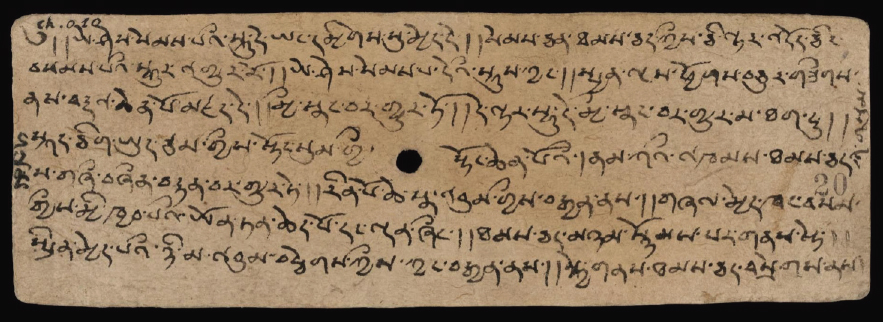
IOL Tib J 507, folio 1r, the third folio of the Ekajati Manuscript.
Ekajati in the Mandala
The anonymous author of the Ekajati Manuscript characterizes the text as a “memorandum” (brjed byang), meaning that the reader is expected to know the mandala already, having received empowerment into it, and either having read or received orally the full description of the practice. Nevertheless, the author’s description of the lotus mandala is quite long, and unfolds as a visualisation practice that also reads like a narrative. Throughout the Ekajati Manuscript, the lotus mandala is presented as a representation of the female nature in Vajrayana. The words of homage that begin the instructions of the mandala feature only female deities:
I prostrate with supreme faith to Jñānasattvī and all of the other bhagavatīs, the divine mothers of the buddhas; to the goddess of beauty and all the other offering goddesses; and to the leader of the wrathful goddesses, Ekajati, with her ocean-like entourage of all the wrathful goddesses.[35]
The practice starts with the practitioners visualizing themselves as the male deity Jñanasattva, and the mandala as a traditional five-deity arrangement, though with some unusual variations on the buddhas’ names. This sets a normative framework, yet the visualisation of male deities is immediately dissolved and replaced with the figure of the divine mother Jñānasattvī. The goddess, the female counterpart to Jñānasattva, is presented as equally all-encompassing in her enlightened nature. She is also characterized as fundamentally female, the mother of all the buddhas.[36]
Then the great divine mother of the tathagatas, Jñānasattvī, having seen the mandala of her own body, understands it as the nature of women, and smiles.[37]
Here, the Tibetan word for woman, bud med, is the one used for an ordinary human woman, not a female deity.[38] The implication is that the mandala is a representation of the enlightened nature of any and every woman, with Jñānasattvī’s smile indicating a delight in this mandala as representation of the female body. The lotus mandala in the Ekajati Manuscripts thus creates a space entirely inhabited by female deities, which itself represents the nature of all women.[39] In this, it is different from the other lotus mandalas found in the Dunhuang manuscripts, which feature both male and female deities.
After Jñānasattvī has announced her presence, she produces three further goddesses, Cundā from her heart, Kurukullā from the palm of her left hand, and Ekajati from her left foot. None of the goddesses are described in detail here. We can infer that Ekajati has two arms, as she holds a vajra cutter and a weapon called the khangari (khang ga ri). This detail already distinguishes this Ekajati from the one in the Seventeen Tantras, and other early traditions. Nor is there any suggestion here either of her later form in Nyingma practices, with a single eye, one fang, and one breast.
Ekajati is named interchangeably in the text in Tibetan (ral pa cig) and Tibetanized Sanskrit (e ka dza ti). While Jñānasattvī is stationed at the center of the mandala, Ekajati is free to traverse it, roaming from one gate to another and opening them with her weapon in turn to allow the goddesses Cundā and Kurukullā to enter. After Ekajati has opened these two mandala gates, she makes an extraordinary speech in which she proclaims her role as encompassing not only this mandala but all buddhas, bodhisattvas, and wrathful deities:
“Hey! I am the skillful means of all the buddhas and bodhisattvas, and I am the secret natural mandala that is displayed by all the wrathful ones. As the enlightened mind of Jñānasattvī, I am inspired by Cundā and devoted to Kurukullā. I am the place of origin of all the buddhas, the birthplace of the bodhisattvas, and the place where the wrathful ones play.”[40]
These rhetorical flourishes seem intended to invoke a sense of wonder at the figure of Ekajati.[41] As with Jñānasattvī, the female nature of Ekajati is emphasized, and she too has the role of the mother of all buddhas. Here we don’t have the term “mother” but instead “place of origin” (’byung gnas) and “birthplace” (skye gnas). The last part of this speech extends Ekajati’s influence to all women who have excelled on the Buddhist path, with poetic emphasis in her repetition of the verb “put there” (gcug go) three times:
“The women who take the form of advanced practitioners are all made by me. The four signs of virtue and accomplishment are put there, are put there, are put there by me!”[42]
Here, again, the text emphasizes the role of women, not just in terms of the enlightened deities of the mandala, but as ordinary women (bud med); in this case, specifically women on the Buddhist path who become advanced practitioners (skyes bu chen po). Ekajati is thus presented here as a kind of patron deity for female practitioners.
After the goddesses have been introduced, the mandala itself appears in a similarly awe-inspiring way: “In the middle of the expansive jeweled ground, there is a fearful noise like the roar of a thousand thunderclaps, and a great sound of ‘Hum!’ comes forth.”[43] The scale of the mandala itself is awesome too, spanning the length of a yojana (dpag tshad), a distance that was somewhere between five and eight miles. And in her final statement, Ekajati positions herself as the mandala’s key agent, source of joy, and liberating force:
“I make the chief deities of the wrathful goddesses burst out laughing with joy. I liberate all beings, from the pinnacle of existence to the hells, into this mandala.”[44]
This statement also helps us to understand the ritual context of this lotus mandala, about which the manuscript is otherwise silent. This is, in the words attributed to Ekajati, a mandala for liberating beings from all of the six places of rebirth. This places it firmly in the funerary tradition of mandalas such as those related to the Sarvadurgatipariśodhana tantra. Matthew Kapstein has studied two lotus mandalas related to this funerary mandala tradition, appearing in the manuscripts IOL Tib J 318 and 584. Kapstein suggests that these mandala rituals are a link between the Sarvadurgatipariśodhana mandalas, and the hundred-petalled lotus mandala of the later Nyingma cycle known as Stirring the Depths of Hell (na rak dong sprugs). What they all share is that the practices are intended to liberate sentient beings from the unfortunate rebirths. While the lotus mandala in the Ekajati manuscript is different from the texts studied by Kapstein, it seems to share the same purpose as these other lotus mandalas.[45]
In her final act, Ekajati grinds a vajra pestle (rdo rje gtun) in a mortar (khungs). The introduction to the Ekajati Manuscript states that the vajra pestle will be explained, but there is in fact no further discussion of it. In the absence of an explanation, we can detect what seems to be sexual symbolism, perhaps standing in for the absence of male deities. Among other Dunhuang manuscripts, the vajra pestle does not appear often, but is mentioned in the Noose of Methods tantra in IOL Tib J 321. Here the sexual symbolism of the pestle and mortar is more obvious:
Meditate on the vajra pestle grinding
In the fierce mandala of the female wrathful one
Like the beating hammer of the male wrathful one;
If you do this even the gods will be beaten.[46]
Thus perhaps the role of the vajra pestle in the Ekajati Manuscript is to invoke a sexual union that is not visualized due to the lack of any overlap between male and female deities in the lotus mandala. Elsewhere as well in the text, the goddesses’ role embodying sexual desire is very explicit, Kurukullā declares: “Hey! I am the woman mad with desire. I am the site of all the buddhas’ lust, and I open the mandala gate that allows for their great play.”[47]
After the narrative in which Ekajati brings Cundā and Kurukullā to the mandala, we come to the second part of the mandala text, the “memorandum” or list of the other deities who fill the hundred petals of the lotus mandala. Most of the names of the goddesses here, which I have not seen elsewhere, have strong sexual connotations; the first five named are Smiling Woman (’dzum ma), Shameless Woman (g.yo mo ma), Concealed Desire (’dod pa’i ngos myi shes), She Who Constantly Offers Nectar (rtag tu ’dud rtsi chu ’byin ma) and She Who Shows How to Give Joy (dga’ ba’i sbyin ston ma). These five are followed by lists of twenty-five and four further goddesses.[48] Along with other goddess groups, not named individually, the mandala is filled with a hundred female deities. Here once again Ejakati’s special role in the mandala is emphasized. She is the “ground bearer” (sa ’dzin pa) who supports the entire mandala and can come and go across all of its stations, roaming the mandala, with no single fixed place. The Ekajati Manuscript ends with a very brief discussion of the empowerment or blessing conveyed by the mandala, and the need for those who receive it to maintain samaya vows, before dissolving the mandala and its deities.[49]
Dzogchen in the Ekajati Manuscript
As we have seen, the author of the mandala text in the Ekajati Manuscript states that the sources of the practice are the tantras of the secret mantra and the sutras of Dzogchen. We have looked at Ekajati’s role in the Dunhuang manuscript and how this may be linked to the later Dzogchen tradition, but does the author’s statement suggest that there should be more in this text to show its derivation from Dzogchen texts? The most relevant part of the text is a passage near the beginning, before the mandala is laid out:
All phenomena are encompassed by the dharmakāya, and the dharmakāya is itself encompassed by the jñānakāya. Since all sentient beings are pervaded by the compassion of the jñānakāya, compassion arises in each of their individual minds. The three realms are pervaded by the dharmakāya, and in this sameness, are blessed by this great intention, and this makes them free from causation. In this way, all the three realms are also pervaded by the blessings of compassion.[50]
In the catalogue of the Tibetan tantric manuscripts from Dunhuang at the British Library, we connected this passage to the three concentrations typical of Mahāyoga sādhanas at Dunhuang, rather than to any Dzogchen influence.[51] While there may be a connection, I now think we should take the text’s own invocation of Dzogchen sources more seriously. There is relatively little in this passage that can be linked to the other Dzogchen manuscripts from Dunhuang, or what is considered the earliest stratum of Dzogchen texts; instead what we see here points forward in time, to the language of the Seventeen Tantras.
The jñānakāya, or “wisdom body,” indicates the enlightened nature of buddhahood. Though less commonly seen than the classic triad of dharmakāya, saṃbhogakāya and nirmaṇakāya, it is invoked in some sutras and many tantras.[52] The jñānakāya also is invoked extensively across the Seventeen Tantras, and similarly to the passage here, is sometimes discussed alongside the dharmakāya.[53] For example, in the fifth chapter of Lion’s Perfect Energy:
I teach all appearances as the jñānakāya,
Which itself is intrinsic awareness,
Appearing as nondual with objects.
The dharmakāya is free from all substantiality,
And has always been luminous by nature.[54]
As a personification of the jñānakāya, the male and female deities Jñānasattva and Jñānasattvī represent the most abstract form of buddhahood in the Ekajati Manuscript. While one might expect Samantabhadra to fulfill this role in all Dzogchen texts, this is not always the case, and certainly in the Seventeen Tantras.[55] In some we find Vajradhara in this role, though this was finessed in the later commentarial tradition to make Vajradhara a saṃbhogakāya, or a nirmaṇakāya, deity.[56] Elsewhere, Jñānasattva takes the role of all-encompassing buddha; for example in the sixth chapter of the Lion’s Perfect Energy where the four empowerments of Dzogchen are introduced:
Kyema! Listen about the self-appearing mandala!
The mandala of Jñānasattva
embodies all empowerments and samayas.
Yet it is taught in this way–
there are four kinds of empowerment,
outer, inner and secret,
and then absolute perfection.[57]
Here, as in the Ekajati Manuscript, Jñānasattva seems to be a dharmakāya buddha rather than the wisdom aspect of a specific deity.[58] This is also apparent in the Dunhuang text where, before the mandala appears, Jñānasattva becomes invisible and is said to pervade everything as the ground (gzhi).
The concept of sameness (mnyam pa nyid) invoked at the beginning of the Ekajati Manuscript is also found in early Dzogchen texts, including those from Dunhuang, and throughout the later Dzogchen tradition as well.[59] Freedom from causation (rgyu dang bral) is a common theme in Dzogchen texts, though it is also found in other forms of Buddhist literature. The transcendent use of the term “great intention” (dgongs pa chen po) also particularly points to the Seventeen Tantras and the later Nyingthik tradition. In this tradition, dgongs pa may be used with its general meaning of intention or purpose (or more broadly, the mind that has this characteristic), but increasingly stands for an entirely enlightened mind or state of being. See for example the Tantra of Awareness Rising:
The true meaning of Dzogchen is free from guarding as there is no causal guarding of samaya vows. A nonexistent yet spontaneously present oneness—this is the great intention (dgongs pa chen po) of all Secret Mantra. This is Dzogchen Atiyoga.[60]
Finally and perhaps most importantly for this key passage in the Ekajati Manuscript, the key concept here is compassion (thugs rje). Rather than a virtuous state of mind, compassion here is an all-pervasive energy pervading the universe. This ontological role for compassion is characteristic of the later Nyingthik, where compassion is one of the three aspects of the ground (gzhi), alongside its essence (ngo bo) and nature (rang bzhin). Again, from the Tantra of Awareness Rising:
What we call the “great ever-pure ground” abides with three aspects: essence, nature and compassion. Its essence is unchanging wisdom, which we call “the natural state of the youthful vase body’s unobstructed clarity.” Its nature is the unobstructed manifestation of the five lights. The manifestation of its compassion is like [the sky] without clouds.[61]
While the Ekajati manuscript is not explicitly discussing compassion as an aspect of the ground, it is using the concept in a similar way, to join the macrocosm (the three realms) with the microcosm (the mind of a sentient being). Indeed the use of the verb “pervade” (khyab) here in the Ekajati Manuscript directly links us to the later Nyingthik tradition where the standard description of the ground’s compassion is that it is “all-pervading” (kun khyab).[62] Does this help us understand what the author of the Ekajati Manuscript may have had in mind in claiming sources in the sutras of Dzogchen? I am not sure, but it is interesting to see commonalities with the later discourses of the Seventeen Tantras, especially alongside the figure of Ekajati, whose significant presence spans the Dunhuang manuscript and the Seventeen Tantras.
Dzogchen, Rituals, and Zombies
The Seventeen Tantras themselves contain much that, if treated in isolation, would not be what is usually thought of as Dzogchen practice. Though their origins are unknown, the Seventeen Tantras first circulated in the eleventh century, a hundred years or so later than the Dunhuang manuscript we are looking at here. Modern scholarship generally considers them to have been composed in Tibetan, rather than being translated from another language. As Bryan Cuevas has said, these tantras seem to be the end result of a long period of compilation and composition by several people; in that case many of their constituent parts could certainly date back to the tenth century.
The Seventeen Tantras do not in themselves present a consistent picture of Dzogchen. It was later exegetes such as Nyima Bum in the thirteenth century, and most influentially, Longchenpa in the fourteenth, who developed systems of theory and practice based on these texts.[63] Perhaps the most striking thing about the Seventeen Tantras, compared to these later traditions of interpretation, is the presence of many ritual elements that are not usually considered to belong to the category of Dzogchen. The presence in these tantras of wrathful female deities, tantric empowerments, and other ritual instructions in the Seventeen Tantras has recently been discussed by Khenpo Yeshi:
Early Nyingthik texts such as the Seventeen Tantras and those found in the Four Volumes and One-hundred Nineteen Esoteric Precepts of the Vima Nyingthik are infused with tantric elements and rituals such as The Bronze-faced Dark Maroon Wrathful Lady (Smug nag kros ma rag gdong ma) of unknown authorship, and The Elaborate Empowerment of the Dzogchen Nyingthik (Rdzogs pa chen po snying thig spros bcas kyi dbang) by Chetsun Sengé Wangchuk (Lce btsun seng ge dbang phyug, 12th c.). The Tantra of the Unlocking through Sound includes elaborate alchemical practices and ways of contemplating the sounds of the elements.[64]
In this rich ritual mélange there is one theme that predominates across the Seventeen Tantras; here, Dzogchen is primarily a tradition that deals with death and the rituals that accompany death. This includes introducing the dying or dead person to the true state of their own mind, and guiding them through the intermediate state, as well as extensive ritual instructions that include empowerments and ritual feasts for the pantheons of peaceful and wrathful deities, procedures for cremation and other funerary practices, and magical practices involving the dead.
We can take one of the Seventeen Tantras as an example, the Great Self-arising Perfection.[65] Like many of these tantras, it is dedicated to funerary ritual practice, with the opening chapters setting out rituals for “a yogin who has passed away” (rnal ’byor pa tshe ’das pa). Later chapters describe rituals for the bardo, including the mandalas of peaceful and wrathful deities, special empowerments specific to this tradition, and towards the end, a teaching on the Dzogchen view. The Great Self-arising Perfection is certainly a Dzogchen text in that concepts such as spontaneous accomplishment (lhun grub) and primordial purity (ka dag) occur throughout, and the more specific practices of breakthrough (khregs chod) and leapover (thod rgal) and are referenced. Such concepts particularly inform the chapters on guiding the dead through the post-death state (ch.6) and on the view of the Dzogchen (ch.21).
The Great Self-arising Perfection as a whole can be seen as a manual for dying and the activities around death. One chapter from the tantra has already been translated and discussed by Michael Walter—the instructions for making a zombie (ch.9). This practice combines a ritual of raising a corpse with a kind of alchemy in which the corpse’s tongue transforms into gold and becomes a substance that confers the ultimate accomplishment when eaten. This zombie chapter is not out of character for a Buddhist text; Peter Skilling has discussed instructions on raising a zombie in the Pali canon (albeit framed in terms of a prohibition), and Walter has shown that there are many Indic sources on reanimating the dead in both Buddhist and Hindu traditions.[66] The zombie practice in the ninth chapter of Great Self-arising Perfection involves a detailed ritual instruction for laying out a physical mandala on the ground, much like those seen in Indic Buddhist dhāraṇī literature and tantras, with ritual materials including arrows, coloured threads, and torma. After practices to liberate the consciousness of the deceased, further rites take place involving beheading the corpse and taking out its heart. The corpse is only animated briefly, at which point the consciousness of the deceased is fully liberated. The corpse’s tongue is kept by the yogin, and with a further two years of sādhana practice, turns into gold, after which it can be eaten with honey and water, and will confer enlightenment.
This zombie practice has the effect of making the Great Self-arising Perfection look more like earlier Indic tantras such as the Guhyasamāja, which comprise a mixture of ritual practices for various purposes. The Seventeen Tantras do not look like a radically new form of sacred literature, but more an evolution of an Indic genre, though almost certainly composed or compiled in Tibet. The Great Self-arising Perfection also embodies a trend that we see in Dunhuang—the practice of peaceful and wrathful deity rituals in succession for a funerary purpose.[67] The most famous example of this trend came later in Tibet, in the terma cycle known as The Peaceful and Wrathful Deities of Karma Lingpa (kar gling zhi khro), and much later still in English translation as The Tibetan Book of the Dead.[68]
As well as there being a strong precedent in Indic tantra for the range of ritual practices in the Seventeen Tantras, the way the instructions are grouped also has a practical logic. After all, why shouldn’t an introduction into the nature of mind sit alongside instructions for making the molded votive offerings known as tsatsa, or cremating a corpse? Both things might well be accomplished in the same day by a single person or small community. Equally, these texts clearly belong together when they are all practiced in a specific context, in this case, funerary rites.
Dzogchen Practitioners in the Tenth Century
Our picture of early Dzogchen has been influenced by the discovery and study of two Dunhuang manuscripts as the “earliest surviving Dzogchen texts.” These two manuscripts (IOL Tib J 594 and 647) were first discussed as such by Namkhai Norbu in The Crystal and the Way of Light (first published in 1986) and then by Samten Karmay in The Great Perfection (first published in 1989). The two manuscripts are commentaries on very short treatises on the nature of mind. Both texts present the qualities of enlightenment as spontaneously present and speak against the idea that meditation practice of any kind has a causal link to these qualities. Due to this, and the lack of explicit practice instruction, both texts have been considered to be equivalent to the later Mind Series (sems sde) category of Dzogchen texts—and indeed the very brief root text in IOL Tib J 647, known as The Cuckoo of Awareness (rig pa’i khu byug) was incorporated into later collections of Mind Series texts.[69]
However, there are other Dunhuang manuscripts that must also be considered in any discussion of early Dzogchen. The plurality of Dzogchen in its earliest appearances is evident in Dylan Esler’s overview of Dzogchen texts from Dunhuang, which includes the manuscript IOL Tib J 454, a text which does not use the term rdzogs chen itself, yet applies the approach and language of early Dzogchen in a Mahāyoga context.[70] Equally, we find the term rdzogs chen in a Mahāyoga sādhana from Dunhuang (in the manuscript IOL Tib J 437), where it is used in the context of the culmination of sexual yoga.[71] None of these texts can be taken to represent exclusively the true public face of Dzogchen in the tenth century. Rather they reveal a local example of a tradition that was in development, and in which Dzogchen was thoroughly interdependent with a variety of other Buddhist practices.
So who produced these manuscripts? Another important line of inquiry into the social context of the earliest surviving sources of Dzogchen is handwriting. If we take just the two famous early Dzogchen manuscripts, IOL Tib J 594 and IOL Tib J 647, an analysis of their handwriting does provide us with further clues as to who was writing them and the context in which they were produced. Both texts share a very similar cursive style. In general, this style is seen across many Tibetan manuscripts from the Dunhuang collections, the majority of which contain practices such as sādhanas, empowerments, tantric feasts, and torma offerings. It is very likely that they all date from the tenth century. This alone cautions us against taking these Dzogchen texts as separate in any meaningful way from various other practices of tenth-century tantric Buddhism.
We can narrow down the selection by looking at a group of manuscripts with handwriting that suggests they may have been written by the same person, or small group of people, as these two Dzogchen manuscripts:[72]
 IOL Tib J 331—This manuscript contains a sequence of sādhana texts. The first is a visualisation practice for purifying body, speech, and mind; the second is a deity yoga practice that is explicitly based on the Guhyasamāja tantra and includes elements of both the generation and completion stages, including sexual yoga; the third is a ritual focused on the wrathful deity Vajrakilaya.[73]
IOL Tib J 346—This pothi manuscript contains a sādhana titled The Wisdom Garuda (ye shes mkha’ lding), a wrathful deity yoga practice; this is followed by a brief discussion of the samaya vows and the penalties for infringing them.
IOL Tib J 464—This manuscript contains a sādhana that is very similar to the second text in IOL Tib J 331. In fact Jacob Dalton has shown that the former is an expansion of this text; it is followed by notes on the structure of a tantric ritual.[74]
IOL Tib J 552—This manuscript contains a deity yoga sādhana focused on Vajrasattva. Very similar sādhana practices are written in the manuscripts IOL Tib J 553 and 554, suggesting that these three manuscripts were written by three people closely associated with each other, and working or learning together.[75]
This group of manuscripts that appear to be written in the same hand as the manuscripts containing Dzogchen texts are sādhanas focused on Mahāyoga deity practice, with a common focus on the deity Vajrasattva, and involving visualisation, sexual yoga (whether visualized or performed) and empowerments. This, then, is the immediate practice context in which we find Dzogchen texts in the Dunhuang manuscripts.
A wider selection of the manuscripts can be delimited by including the associates of this writer, the people who wrote the sādhanas in the manuscripts IOL Tib J 553 and 554. The handwritings of these two scribes are found in many more manuscripts. The writer of IOL Tib J 553 is distinguished by Khotanese elements in some of his or her manuscripts, including page numbers and some textual connections.[76] As well as more Mahāyoga sādhanas, the texts in this hand include ritual instructions, such as on torma, especially the “water torma” (chu gtor), fire offerings, and treatises on the features of stupas and counting beads. The writer of IOL Tib J 554 was equally prolific; in this hand we find manuscripts containing Mahāyoga sādhanas, including an interesting set which incorporate Chan elements, as well as long and complex rituals for the tantric feast; this scribe also wrote many more non-tantric texts on general Buddhist themes.[77]
These manuscripts strongly suggest that the undermining of ritual activity in Dzogchen seen in IOL Tib J 594 and 647 was not taken as a literal instruction to avoid tantric sādhana practice, but was incorporated into those practices. This is further confirmed by the faint notes on the last folio of IOL Tib J 647. Though they have been badly abraded, their sense is still clear enough. The sentence begins, “despite non-activity,” mentions the text itself, “the precepts of the Cuckoo’s Hidden Grain,” and a book (probably the manuscript itself) and then “do this diligently every morning and evening.” The prescribed activity is not clear, but another clue is that Vajrasattva’s hundred-syllable mantra is written below these lines on the same final page of the manuscript. This suggests a connection with the practice of Mahāyoga sādhanas in the manuscripts written in a very similar hand that we have just discussed.
The manuscripts from Dunhuang can represent only the local community of that particular place during the ninth and tenth centuries, and of course many other communities of practice, whose manuscripts and ritual materials no longer survive, existed elsewhere. So we must avoid the temptation to generalize about trends in the Tibetan cultural sphere from this specific source. Yet it is worth noting, and perhaps further exploring, the continuity in the transition from the ritual interests demonstrated in the Dunhuang manuscripts to the heterogeneous discourse of the Seventeen Tantras, with their mix of funerary ritual, tantric visualization practice and the transcendent rhetoric of Dzogchen. Clearly there were many sources for the Seventeen Tantras, and so much was included in these texts that we should not expect to find all of it represented among the Dunhuang manuscripts; indeed, some of the most characteristic practices of the Instruction Series—breakthrough (khregs chod) and leapover (thod rgal), and the special empowerments for Dzogchen—are not seen in any form among the manuscripts. What we do see again and again, is Dzogchen situated in a context of the meditative practices and ritual interests outlined above, from the Dunhuang manuscripts to the Seventeen Tantras, and then from the early major terma cycles such as the Lama Gongdu (bla ma dgongs ’dus), to the recent and still-popular cycles such as the Longchen Nyingthik (klong chen snying thig).
In one of his groundbreaking articles on the history of Dzogchen in Tibet, David Germano introduced the idea of “the funerary transformation” of Dzogchen, specifically in the later traditions within Dzogchen that were inspired by the Seventeen Tantras.[78] Without disagreeing with Germano’s view of the Seventeen Tantras as revolutionary documents in the Dzogchen tradition, I would suggest that rather than seeing in them a transformation of Dzogchen, we can see an incorporation into new scriptures of the milieu of practice in which Dzogchen was already fully embedded by the tenth century, if not earlier. The Ekajati Manuscript suggests that one of the aspects of this milieu was the increasing importance of the goddess Ekajati in practices associated with Dzogchen.
It would be too much to call the Ekajati Manuscript a “proto-Nyingthik” text—as we have seen, there is much in the Seventeen Tantras that is not found here, or in any Dunhuang manuscript. Nevertheless the presence in the manuscript of Ekajati herself, and the author’s stated indebtedness of the sutras of Dzogchen, suggest we should consider the text among the kinds of sources that flowed into the heterogeneous content of the Seventeen Tantras, and thereafter the texts and practices of the Dzogchen Nyingthik. The presence of Ekajati in a mandala of goddesses that does not derive from any obvious Indic source, and other elements in the manuscript which have some similarities to the Dzogchen of the Seventeen Tantras point in this direction. There are suggestions in the Ekajati Manuscript, as we saw earlier, that the purpose of its mandala was the liberation of beings from all forms of rebirth after death, placing it in the same ritual context as so much of the content of the Seventeen Tantras.
Conclusion
For many centuries the wrathful goddess Ekajati has been considered the principal guardian of the Dzogchen teachings. Often depicted with one eye, one tooth, and one breast, she is also a visual metaphor for Dzogchen’s key teaching of nonduality. Ekajati appears repeatedly in the visionary accounts of figures such as Shangtönpa, Longchenpa, and Jigme Lingpa, assuming a role as both a protector and an active force in their transmission of the teachings. Yet her origins present us with a puzzle, one that involves a complex interplay between Tibetan and Indian tantric traditions. As we have seen, textual evidence suggests that Ekajati’s transmission history may have followed an unusual path, from Tibet to India and back again. Sanskrit sources like the Sādhanamālā describe forms of Ekajati that are said to have been derived from earlier Tibetan or Central Asian traditions. Thus the ritual traditions of the new schools such as the Sakya, based on translated Indic works, may have reintroduced Ekajati to Tibet.
The Dunhuang manuscripts reveal an earlier stratum of ritual practice that predates these developments. In particular, the Ekajati Manuscript (Pelliot tibétain 353 / IOL Tib J 507), presents us with vivid mandala of female deities. The goddess Ekajati presides over the mandala, a proud and forceful presence, just as she came to be the key inspirational figure for the transmission of Dzogchen. I have suggested that the Ekajati Manuscript can be read as part of a movement towards the forms of Dzogchen seen in Seventeen Tantras and later terma cycles in the following centuries. Equally, placed in its context in the ritual communities of Dunhuang, the manuscript is testament to Dzogchen’s deep entanglement with a range of ritual practices, and especially funerary rites, in the ninth and tenth centuries. While these elements have sometimes been seen as later additions to an originally pristine and anti-ritualist discourse, the manuscript evidence suggests that Dzogchen, in its earliest form known to us, was interwoven with a broader ritual and visionary culture.
Finally, a striking feature of the Ekajati Manuscript is its dedication to presenting a mandala fully comprising female deities as a representation of women on the Buddhist path. As stated in the text, the mandala is a body, and this body is female; specifically, it is said to represent the nature of women, where the Tibetan word bud med indicates not the abstract or enlightened representation of female energy in a deity, but the very ordinary concept of a woman. Similarly, we hear Ekajati proclaim in the text that she is responsible for all the women who appear in the world in the form of great practitioners. In this respect the text seems unique among the Dunhuang manuscripts, at least those that have been studied. Was this a practice developed for, and written down by, female practitioners? There are no obvious clues in the Ekajati Manuscript, but it would certainly be worth pursuing this in any future research into the various manifestations of Ekajati in Tibet.
Translation
The two parts of the Ekajati Manuscript, Pelliot tibétain 353 and IOL Tib J 507, are translated here together, with folio numbers from the manuscript itself in square brackets. The original Tibetan text on both manuscripts can be read in the digital images of the manuscript on the IDP website (idp.bl.uk) and for Pelliot tibétain 353 only, the Gallica website (gallica.bnf.fr).
Pelliot tibétain 353
[1] Here are the characteristics of the natural mandala endowed with means and wisdom. Here too will be shown the characteristics of the principal deities of the mandala of methods. For a detailed and extensive [version], detailed teachings are from the tantras of Secret Mantra and the sutras of Dzogchen. Here we will establish the nature of the mandala, just saying a few words as a memorandum on the following topics: How does it arise and what are its qualities? Where is it to be accomplished, and by whom? Who are the substances of accomplishment offered to? What is the position on the mandala of the women of the mandala, such as the divine mothers of the lineage? The principal deities of the mandala of means; how the lotus lake arises from the vajra mandala; the positions of the tathagatas and bodhisattvas; the characteristics of the wrathful ones; the function of the vajra pestle; those emanated from three-pointed vajra and those created by the one-pointed vajra; and the dissolution of the emanations into light rays.
* * *
I prostrate with supreme faith to Jñānasattvī and all of the other bhagavatīs, the divine mothers of the Buddhas; to the goddess of beauty and all the other offering goddesses;[79] and to the leader of the wrathful goddesses, [2] Ekajati, with her ocean-like entourage of every wrathful goddess.
The mandala of the celestial palace comes first. It is the great purity by nature, and does not arise from a cause. Now to explain the characteristics of this and the five majestic ones who are the principal deities of the mandala.
All phenomena are encompassed by the dharmakāya, and the dharmakāya is itself encompassed by the jñānakāya. Since all sentient beings are pervaded by the compassion of the jñānakāya, compassion arises in each of their individual minds. The three realms are pervaded by the dharmakāya, and in this sameness, are blessed by this great enlightened state, and so made free from causation. In this way, all the three realms are also pervaded by the blessings of compassion.
However, sentient beings are entangled in the imprints of deluded actions under the power of Mara, and by unafflicted imprints too. Not understanding the unparallelled blessings of the teaching, they wander in the five kinds of birth and the five sufferings. Seeing this, one has compassion for them. As a remedy which comes from the minds of each and every sentient being, the illusory images [come forth] from the wisdom of the dharmakāya purity. As a remedy which overcomes all illusions of the three realms, the image of the kāya of compassion [comes forth]. The splendour of all sentient beings is transformed into the [pure] land. The illusory kāya called Jñanasattva comes forth.
IOL Tib J 507
[3] [You have] the body of Jñanasattva, yet you are without fixation. All the desires of sentient beings and [your own] wishes are granted. Also, with the body of Jñanasattva, your five eyes see the ten directions, making you vastly pervading. You become invisible. As soon as that body becomes invisible, in a split second, you become the support, like the ground, of all the sky-like realms of the universe. From being adorned with the jewelled vase, you are endowed with the great qualities of the inconceivable celestial palace, and you abide in the equality of all. From being ornamented by the layered vase of the unclouded sun, all the places of rebirth are burned up and abide in sameness.
In the middle of the expansive jewelled ground, there is a fearful noise like the roar of a thousand thunderclaps, and a great sound of HUM comes forth. Inconceivable noble qualities manifest over the length of a yojana, in the form of a vajra with a hundred spokes, marked with a the hundred-syllable heart mantra.
In the east, the same great sound comes forth. An inconceivable number of qualities come forth and remain in the form of a nine-spoked vajra marked with SA TVA HUM. Around the south, the same great sound comes forth; a five-spoked vajra marked with the heart mantra RAT NA BA DZRA comes forth and remains. [4] In the west, the same great sound comes forth, and becomes a one-spoked vajra marked with an empty lotus, in which is the heart mantra PADMA BA DRZA. North of the centre, the same great sound comes forth, and becomes a great three-spoked vajra, marked with inconceivable qualities in the form of the heart mantra KAR MA HA.
From the heart mantras of the great hundred-spoked vajra, light emanates into the four directions, and dissolves into the other four vajras. Upon dissolving, these lights disappear, and instantly on the nine-spoked vajra to the east, upon a lotus seat, is the king of the gnostic mantras, noble Vajrasattva, ornamented with all the ornaments, and abiding with his entire retinue. In the south, upon the vajra and a lotus seat, is the king of the gnostic mantras of the jewel family, the one called Ratnaketu, ornamented with all the ornaments, and abiding with his entire retinue. In the west, upon the vajra and a lotus seat, is the king of the gnostic mantras Fair-faced Padma (pad ma bzhin bzangs), ornamented with all the ornaments, and abiding along with his entire retinue. In the north, upon the vajra and a lotus seat, the one called Indubitable Accomplishment Haha (gdon mi za bar grub pa ha ha) abides with his consort and retinue.[80]
From the nine-spoked vajra [in the east] the heart mantras, the heart mantra of the one called Sattvavajra (sa tva badzra) shines out like starlight through a polished window.[81] [5] It dissolves into the five-, one- and three-pointed vajras, and immediately it touches them: from the five-pointed vajra comes a light like lapis lazuli, from the one-pointed vajra comes a light like a padmarāga, and from the three-pointed vajra comes a light which is green like an indraketu.[82] Those lights immediately mix together, and like a flash of lightning, swiftly dissolve into the nine-pointed vajra. From that nine-pointed vajra the heart mantra RA GA RA TI comes forth. It becomes the divine mother of all the buddhas of the buddha families, a great being in the form of a woman, Jñānasattvī, at the right of the hundred-pointed vajra. She speaks the following words:
“Hey! I am the sublime one who holds the joys of all the buddhas without letting them go. The great inspirational goddesses arise from me. The mistresses of the mandala are sent by me. But no fabricated bliss comes from me.”
So saying, she remains in this way.
From the heart of Jñānasattvī a red light is emanated and absorbed. In a mere click of the fingers, the divine mother of all the buddhas of the buddha families, the inspirational goddess Cundā (skul byed ma), a great being in the form of a woman, appears to the right of the five-pointed vajra. She says:
“Hey! I am the sublime one who inspires all the buddhas. [6] By spreading open my eighteen arms I make the eighteen emptinesses.”
So saying, she remains in this way.
From the middle of the palm of the left hand of Jñānasattvī, a deep red light radiates and is absorbed into her heart. Kurukullā (’dod chags rgyal mo), a luminous red like a ruby lotus, appears on the right of the one-pointed vajra. She says:
“Hey! I am the woman mad with desire. I am the site of all the buddhas’ lust, and I open the mandala gate that allows for their great play.”
So saying, she remains in this way.
From the left foot of Jñānasattvī, a dark black light comes forth. Having emanated in the ten directions, it is absorbed again immediately. Making the wrathful sound of the heart mantra E KA GRO DA HA, Ekajati appears in the form of a great wrathful goddess, on the right of the three-pointed mandala. With her left hand she holds “the meaningful” and opens the gate to the mandala. Brandishing the wish-fulfilling cutter called “the meaningful,” she says:
“Hey! I am the opener of the gate to the supreme pleasure of all the buddhas. Those advanced practitioners who are akin to buddhas are accomplished by me. I am the arising and abiding of all buddhas. Wrathful play is made by me.”
So saying, she remains in this way. Proclaiming HA HA HA, a great dragon-like laugh, she stares in the ten directions with the pose of a wrathful goddess. Her great weapon which fulfils all wishes is the khangari. [7]
Having displayed the mandala that is one’s own body, she now opens the gate to one’s own mandala. Majestically taking vajra strides into the presence of the nine-pointed vajra, she uses her blue khangari as the symbol of means and wisdom in the body mandala of Jñānasattvī to open the gate to the mandala. Then majestically taking vajra strides, she looks with desire focused on Cundā at the right of the five-pointed vajra. Using her blue khangari as the symbol of means and wisdom, she opens the gate of the mandala. Then she takes majestic vajra strides to the joyful lotus bearer Kurukullā at the right of the one-pointed vajra, and using her blue khangari as the symbol, she opens the gate to the mandala.
Then the great wrathful goddess Ekajati, with overflowing radiance, performs the great play in this vastly encompassing mandala. With the song of a wrathful goddess, she proclaims to them all:
“Hey! I am the skillful means of all the buddhas and bodhisattvas, and I am the secret natural mandala that is displayed by all the wrathful ones. As the enlightened mind of Jñānasattvī, I am inspired by Cundā and devoted to Kurukullā. I am the origin of all the buddhas, the birthplace of the bodhisattvas, and the place where the wrathful ones play. I am the holder of the vajra that is the totality of the fates of all sentient beings—the supreme mind (lhag pa’i sems, Skt. adhicitta). All noble ones and sentient beings have previously made offerings to me. I am the one who opens the gates. I am the wrathful goddess, the Cutting Woman (gcod ma). [8] I am the wrathful goddess, the Gone Woman (gshegs ma). The women who take the form of great advanced practitioners are all made by me. The four signs of virtue and accomplishment are put there, are put there, are put there by me!
“The queen of the divine mothers, Jñānasattvī, is the basis that abides as the mandala of the divine mothers. She is also the basis of the chief goddess who creates joy and the goddesses who delight in creating desire. In my aspect as the chief of the wrathful goddesses, I laugh happily. I liberate all beings, from the pinnacle of existence to the hells, into this mandala. From the one-pointed vajra, I open up three points to make a three[-pointed vajra].[83] Striking and grinding the vajra pestle in the vajra mortar, I shout A LA LA HO!”
Having proclaimed this to the ten directions, she remains without making a sound.
Then the great divine mother of the tathagatas, Jñānasattvī, looks upon the mandala that is one’s own body, understands it as the nature of women, and smiles.
Considering the signs of that accomplishment of the natural mandala, and holding in her left hand a single-pointed sword, she captures the gate of the mandala with her sharp sword, and she turns her great consideration on the naturally arisen mandala. Thus, in this mandala, from the blessings of the dharmakāya, the blessings of all sentient beings, and the joy of all the buddhas is brought about. It is the sublime abode of all the bodhisattvas, and the abode of the great play of all emanations and emissaries. Because this mandala is the dharmakāya, [her legs are] not crossed but straight, with her left foot placed as means and the right as knowledge. [9] This mandala now abides as the first phase, and its gates are open.
* * *
In the center is a four-petalled lotus, and in the center of that, a five[-petalled lotus]. In the center of that are the five great divine mothers. On the four-petalled lotus are the 24 great offering goddesses. Inside of the lotus mandala is a wheel with 32 spokes, inside of which 32 great wrathful goddesses are placed. The ground bearer, guru of the mandala, the inspirational goddess, the Bhagavatī is placed. Not situated at the gates, or the residence, or the central place of the mandala, and not needing permission to come elsewhere, Ekajati the Single Braided One (e ka dza ti ral pa gcig) is placed.
Inside of the lotus of the mandala the great wrathful goddesses are situated, marked by the [signs of] the five [families]:[84]
1. Smiling Woman (’dzum ma)
2. Shameless Woman (g.yo mo ma)
3. Concealed Desire (’dod pa’i ngos myi shes)
4. She Who Constantly Offers Nectar (rtag tu ’dud rtsi chu ’byin ma)
5. She Who Shows How to Give Joy (dga’ ba’i sbyin ston ma)
Outside the mandala is a sixteen-petalled lotus, on which are placed:
1. Vajra Iron Hook (rdo rje lcags sgyu ma)
2. Vajra Bliss Bringer (rdo rje bde byed ma)
3. Vajra Aroused [by] Vampires (rdo rje srin mo ’dod ma)
4. Vajra Breaks and Steals (rdo rje bshig ’phrog ma)
5. Vajra Aroused by Demons (rdo rje bdud bskad kyis ’dod ma)
6. Vajra Trembles with Joy (rdo rje ’ga’ ’dar ma)
7. Vajra Vase of Nectar (rdo rje bdud rtsi’i bum pa ma)
8. Vajra Makes Offerings (rdo rje mchod byed ma)
9. Vajra Queen of Saviours (rdo rje sgrol ma’i gtso mo)
10. Vajra Gazes Openly (rdo rje yangs ma’i gzigs ma)
11. Vajra Holds Tight (rdo rje mkhyud byed)
12. Vajra Cries Out (rdo rje sgra ’byin ma)
13. Vajra Grace of Lightning (rdo rje glog gi gzugs ma)
14. Vajra Bringer of Satisfaction (rdo rje tshim byed ma)
15. Vajra Piled-up Hair (rdo rje ral pa brtsegs ma)
16. Vajra Blows on the Fire (rdo rje mye ’bud ma)
On top of a four-petalled lotus inside of that, marked with vajras are the four great divine mothers of the outer [mandala]:
1. Vajrakhada (ba dzra kha da) in the east
2. Vajraraga (ba dzra ra ga) in the south
3. Vajravatingi (ba dzra ba ti ngi) in the north
4. Vajrakaraha (ba dzra ka ra ha) in the west [10]
The two Great Commanded Ones (bka’ non chen mo), and the two Great Ensigns (mngag zhug ma chen mo) are situated on the inner four[-petalled] lotus. On four petals of the lotus of the outer level reside the two pairs of great wrathful goddesses, the Scouts (sprul pa mo) and the Emissaries (phyag brnyan mo), as well as ten Ensigns (mngag zhug ma), making forty in total.
On the petals marked with lotuses, are each of the great goddesses of the outer [part]. Coming out of their shadows, the groups of five and the twenty [goddesses] take their place. [Then there are] the thirty Women of Inner Longing (nang du ’jungs pa’i ma), and thirty goddesses including She Who Leads Into Desire (’dod chags nang du ’dren ma). Throughout the perimeter of the outer level of the mandala, the 108 outer animal-headed goddesses (phra men, Skt. pisaci) are placed. The natural mandala is accomplished and abides beyond the reach of thought.
* * *
Regarding all of these noble ones, divine mothers, goddesses and wrathful goddesses: the divine mothers hold in their hand swords of wisdom from which light emerges, establishing the great intention of the divine mothers in the deities of the mandala. The divine mother of the buddhas, Jñānasattvī, resides in the middle of a lotus at the center of the mandala. Looking in the ten directions, she blesses all the deities of the mandala, and makes their establishment firm. From this come the four signs of the accomplishment of the families, and the mandala is permanently established.
All tathagatas, bodhisattvas, wrathful goddesses, gods and humans and so on must take and maintain the samaya vows. [11] Those with the supreme aim of becoming a successor to the buddha must make dedications, puja, and offerings to the vajra ruler of the mandala.
In the center of the mandala, resting in the reclining pose of a tortoise, [Jñānasattvī] says:
“The name of this mandala is the great lotus mandala. As it is blessed by myself and the others, whoever holds this will be blessed by myself and others, and will be inside the mandala.”
Then in the vajra that holds the supreme minds of all the advanced practitioners, the nine gods [are drawn into] the nine syllables; the twelve gods are drawn into the twelve syllables and fully erased; the ten wrathful gods and goddesses are drawn into the ten syllables and fully cancelled. Then the traces of these syllables disappear into wisdom as well.[85] Regarding the mandala of the joy-bringing expanse discussed earlier: once you have set out the places of the celestial palace and the mandala, [what to do] in order that the noble kings of the mantras and all the wrathful ones come to the mandala has also been discussed earlier.
1. The book was not authored by Namkhai Norbu in the traditional sense, as the editor John Shane explained in his Editor’s Note to the revised edition (Norbu 2000, 11):
The Crystal was originally compiled from the transcripts of tapes of oral teachings given by Chogyal Namkhai Norbu at retreats and lectures in various parts of the world between 1979 and 1986, as well as from notes that I myself made at lectures that were not ‘officially’ recorded. It also includes material arising from private conversations with Rinpoche that took place during the years that I travelled round the world with him, often acting as his translator.
Shane also notes (p.9) that when the book was first published in 1986, “there were no books about Dzogchen available for the general Western reader at the time this book was first published.” Though Herbert Guenther had published books on Dzogchen before this, it is fair to say that these were not really books for the general reader. John Shane has mentioned to me that the original draft for The Crystal was in fact much longer than the published version, and that he was instructed by Namkhai Norbu to cut most of the content in order to create a more succinct introduction to Dzogchen (personal communication, January 2025).
2. Norbu 2000, 136.
3. In this article I have not given Ekajati’s name with diactritical marks to aid readability. In Sanskrit Buddhist sources she is called Ekajaṭī or Ekajaṭā; see Bühnemann 1996, 475. In Tibetan her name is transliterated as E ka dza ti, and sometimes E ka tsa ti.
4. Norbu 2000, 138.
5. As a dharma protector, Ekajati often forms a trio with Rahula and Vajrasadhu (rdo rje legs pa).
6. Rdzogs pa chen po snying thig gi lo rgyus chen mo, 604–605 (ff.52a–52b), de yang khyad par du sngags kyi srung ma e ka dza ti la gtad de skal ldan snying gi bu dang ’phrad par shog //
7. This episode is translated in Dudjom 1991, 580–585, and is the subject of Germano and Gyatso 2000, which also has a translation.
8. Dudjom 1991, 580.
9. Dudjom 1991, 580.
10. Gyatso 1999, 247.
11. Dudjom 1991, 561.
12. Dudjom 1991, 569–570; See also 572: “Ekajaṭī, protectress of the way of secret mantra, Rāhula, the planetary divinity, and the oath-bound Dorje Lekpa obeyed his command, and he could converse with them as with men.”
13. Dudjom 1991, 841, 849, 865.
14. While in this paper I am using a version of the name without diacritics, in Sanskrit sources the name is either Ekajaṭī or Ekajaṭā.
15. The tantra is Dpal bcom ldan ’das ral pa gcig pa’i rgyud kyi rgyal po chen po (D.476). The colophon gives the Tibetan translator’s name as Dge slong byams pa’i dpal; probably Khro phu lo tsa ba byams pa’i dpal (1172–1236).
16. Note the alternate form of the deity’s Sanskrit name Ekajaṭā.
17. Bhattacharyya 1958, 193.
18. Translation from Bhattacharyya 1958, 193.
19. Bühnemann 1996, 475.
20. Bhattacharyya 1958, 193–194.
21. Bühnemann 1996, 480: “The importance of the case of Mahācīnakrama-Tārā lies in the fact that we can gain a clear understanding of the adaptation process of a goddess from a Buddhist Tantric text into a Hindu Tantra.” See also Bhattacharyya 1958, 190–191.
22. As well as the manuscript studied in this paper, Ekajati appears in one other Dunhuang manuscript of which I am aware. This is the long gaṇacakra ritual found in the manuscripts IOL Tib J 419, Pelliot tibetain 36 & 42. The sixteenth textual section, discusses the mandalas and activities of the wrathful goddesses Cundā, Bhagavanī, Ekajaṭī and Kaṣmali. There is no explicit reference to Dzogchen.
23. For a recent study of Cave 17 at Dunhuang, the nature of its contents, and the reason for its sealing, see Doumy and van Schaik 2023.
24. Karen Liljenberg has shown that some early Mind Series texts contain references to lights and bindu that are usually found in the Instruction Series; 2012, 18–20.
25. Rig pa rang shar, Rgyud bcu bdun, vol.3, p.606: ’dod chags kyi rtso mo e ka tsa ti ma.
26. Bka’ srung nag mo’i rgyud, Rgyud bcu bdun, vol.3, 561: dpal chen e ka tsa ti ral gcig ma zhes bya ba / ma mo dang mkha’ ’gro ma rnams kyi rje mo / bdud dang srin mo ’dul bar mdzad pa / rnal ’byor yongs kyi srung ma mo / dpal chen thugs kyi sprul pa sngags kyi bdag mo / gsang sngags gnyan gyi srung ma /
27. Bka’ srung nag mo’i rgyud, Rgyud bcu bdun, vol.3, 561–562: sku mdog mthing nag zhal gcig phyag gnyis ma / g.yas na bram chen gyi tsit ta bsnams pa / g.yon na g.yu’i spyang mo bsnams pa / ral pa nag pos sa gzhi khebs pa / g.yu’i ral gcig ’od du ’bar ba / sku dang ral pa’i gseb nas g.yu’i spyang mo dgu ’bum ’phro ba / thod pa lnga’i dbu rgyan can / spyan gsum mche ba bzhi gtsigs pa / zhal nas khrag dang zhag ’dzag pa / zhing chen gyi stod g.yogs dang / stag gi pags pa’i sham thabs can / zhabs gnyis brkyang ba skum gyis phung byed sbas pa’i ma bzhi mnan pa ni ’di lta ste /
28. Further research into Nyingma ritual literature is needed to trace the development of the different forms of Ekajati. In particular, the one-eyed, one-fanged form of the later Dzogchen tradition is not seen in any of the sources I discuss here.
29. There are several other manuscripts from Dunhuang concerned with goddesses. These include IOL Tib J 727 and Pelliot tibétain 307, both of which discuss a mandala of seven wrathful goddesses (see Dalton 2004). Animal-headed goddesses feature in sādhanas related to the tradition of the Guhyagarbha tantra, incuding Pelliot tibétain 321, IOL Tib J 332 and IOL Tib J 716 (discussed in Tanaka 2020). However, the mandalas in these texts tend to centre male deities, and in the case of Pelliot tibétain 307, the goddesses are subdued by Padmasambhava.
30. See also the discussion of the opening of this text in van Schaik 2004, 177–178.
31. IOL Tib J 507 is inscribed with Stein’s own numbering as Ch.010. This is an unusual format in Aurel Stein’s numbering of the contents of Cave 17 (see Terzi and Whitfield 2024, 65). His numbers Ch.01 to Ch.011 were given to a series of Tibetan pothi and convolute manuscripts and one Chinese scroll. It is possible that these were the very first manuscripts that were removed from the cave by Wang Yuanlu for Stein’s acquisition. These manuscripts were photographed and reproduced in the fourth volume of Stein’s report on his second Central Asian expedition, Serindia (Stein 1921, vol.4, Plate CLXXIV). According to Terzi and Whitfield, Stein may have used this numbering system for many other manuscripts that were subsequently given different numbers—perhaps only Ch.01 to Ch.011 keeping their original numbers such because they had already been published with these numbers in Serindia. Ch.010 (now IOL Tib J 507) is also listed in Appendix I of Serindia along with the other manuscripts in this sequence, where it is described as “Tantric treatise; begins with a description of the Jñānasattvakāya; apparently complete at end.” Stein 1921, vol.3, 1471. The presence of the first two folios of the same manuscript in Pelliot’s collection was apparently not known at the time; this seems to have been first noted in Dalton and van Schaik 2004. It is fairly common for Tibetan manuscripts from Mogao Cave 17, especially loose-leaf pecha, to have been split between two collections in this way.
32. Esler 2021, 413.
33. IOL Tib J 401; see van Schaik 2020, 95.
34. Dalton (2016) discusses the manuscripts IOL Tib J 447 and IOL Tib J 448 as part of a group of texts relating to the Sarvatāthagata Tattvasaṃgraha tantra. He suggests that they date from the ninth century, earlier than most of the other tantric manuscripts from Dunhuang, However, when considering IOL Tib J 507 and Pelliot tibétain 353 as being in the same handwriting, Dalton (2023, 263, n.23) suggests that the content of these particular manuscripts might indicate a later date.
35. IOL Tib J 507, f.1v–2r: bcom ldan ’das ma / sangs rgyas thams cad kyi yum / / ye shes sems ma la stsogs pa thams cad dang / / mchod pa’i lha mo rdo rje sgeg mo la stsogs pa thams cad dang / / khro mo’i gtso mo ral pa gcig ma la stsogs ste / / ’khro mo thams cad dang ’khor rgya mtsho dang bcas pa la // dang mchog gis phyag ’tshal lo //
36. I have translated yum in this context as “divine mother” In tantric texts it is often translated as “consort,” but since Jñānasattvī is the at the centre of the mandala in the Ekajati Manuscript, with no male deity present, the translation “mother” seems more appropriate. “Divine” is added to signal the honorific and transcendent meaning of “mother” in this context.
37. IOL Tib J 507, f.8r–8v: de nas bcom ldan ’das kyi yum chen mo ye shes sems mas / / bdag [g]i dkyil ’khor la gzigs nas // bud myed kyi rang bzhin du mkhyen te // ’dzum ba mdzad do //
38. While unusual in the Dunhuang manuscripts, statements like this are found in the yogini tantras that were translated into Tibetan in the centuries that followed. For example, in the Caṇḍamahāroṣaṇa tantra, the deity Vajrayoginī says, “I am here for the benefit of those women who do not know that I abide in the bodies of all women” (bud med gang gis nga mi shes / bud med kun gyi lus la gnas / bdag ni de rnams phan don phyir); see Shaw 1994, 41. For a recent discussion of the development of the yogini tantras see Hatley 2016.
39. Several examples of statements from these tantras valorising women have been discussed by Miranda Shaw in her study of women’s role in tantric Buddhism. While Shaw’s book argues that women’s agency in tantric ritual and meditation practice equalled or even surpassed that of men, at least in its earlier phases in India, others have disputed this; see for example the review by Judith Simmer-Brown (1995). Note also that one of the fourteen root downfalls, which became increasingly standard in the tantric vows of the new schools in Tibet from the twelfth century onwards, is: “woman have the nature of insight (prajñā), so disparaging them is the fourteenth [downfall]” (shes rab rang bzhin bud med la / smod par byed pa bcu bzhi pa). However such statements were arguably aimed primarily at male practitioners, to counter the denigration of women’s bodies found in non-tantric Buddhist monastic practice.
40. IOL Tib J 507, f.7v: kye bdag ni sangs rgyas thams cad dang // byang cub sems // ye shes sems dgongs nas ni // bskul byed mas ni nga la bskul // ’dod chags rgyal mos bsten byas te // sangs rgyas kun kyi ’byung gnas dang // byang cub sems pa’i skye gnas dang // khro bo kun kyi rol pa’i gnas //
41. See Jacob Dalton’s discussion (2023, 21–26) of poetics in ritual manuals from Dunhuang.
42. IOL Tib J 507, f.8r: skyes bu chen po’i gzugs ’dzin pa’i bud myed dag kyang ngas byas so // dge zhing ’grub pa’i mtshan ma bzhi / bcug go bcug go ngas bzug go /
43. IOL Tib J 507, f.1v: rin po che’i sa gzhi yangs pa’i dbus su // ’jigs pa’i zhur sgra ’brug stong ’dus pa’i sgra ched por dang bcas pa dang // hum zhes sgra ched po byung ste //
44. IOL Tib J 507, f.7v: nga ni (f.8r) khro mo gcod ma yin // nga ni khro mo gshegs ma yin // skyem bu chen po’i gzugs ’dzin pa’i bud med dag kyang ngas byas so //
45. Kapstein 2007. Though they differ in most details, an interesting similarity is that the author of the mandala text in IOL Tib J 318 also characterizes the work as a “memorandum” (brjed byang).
46. Translation from Cantwell and Mayer (2008, 189) Thabs kyi zhags pa’i rgyud, chapter 21, p.65: khro mo’i dkyil khor gtum cen du // khro bo’i tho bas brdungs pa yi // rdo rje gtun ’phrugs bsgoms byas na// lha yang rung ste brdungs par ’gyur/
47. IOL Tib J 507, f.6a: kye bdag ni dod pa’i myos pa mo // sangs rgyas thams cad chags pa’i gnas // rol pa chen po’i rgyu yod kyang gnas rab dkyil ’khor sgo ma phye //
Here “great play” (rol pa chen po) may refer to deities in sexual union, though the phrase is also seen in the later Dzogchen tradition in Tibet with a more ontological meaning.
48. One of the goddesses, Vajra Aṅkuśā (rdo rje lcags sgyu ma), is well-attested elsewhere, especially in the peaceful mandala of the Guhyagarbha tradition. The second goddess, Vajra Kṣemā (rdo rje bde byed ma) is also seen elsewhere. Apart from these, I have not been able to confidently identify any of the supplementary goddesses in the mandala.
49. There is a concluding sentence in the manuscript in which the author seems to be referring to setting up the physical mandala with reference to the male buddhas and deities that appear at the very beginning of the description of the mandala. Since there is blank space on the remainder of the page it appears the original manuscript did end here. The ending seems rather abrupt and lacks a colophon or phrase indication completion (e.g. rdzogs so), though this is not unusual in Tibetan Dunhuang texts.
50. Pelliot tibetain 353, f.2r: chos thams cad ni chos kyi skur ’dus // chos kyi sku yang ye shes kyi skur ’dus // ye shes kyi sku’i thugs rjes // sems can mtha’ dag la thugs rke des khyab par rang rang gyi sems la shar te // chos kyi sku des khams gsum khyab ste mnyam ba nyid du / dgongs pa chen pos bying kyis brlabs nas // rgyu dang bral bar mdzad do // de ltar thugs rje’i byin kyi rlabs (f.2v) kyis // khams gsum thams cad khyab kyis kyang //
51. Dalton and van Schaik 2006, 232.
52. For example, the term jñānakāya appears in the Avataṃsaka sūtra, the Mañjuśrīnāmasaṃgīti, the Saṃpuṭa tantra, and very frequently in the Kālacakra tantra corpus.
53. As well as the passage quoted here, see the passage on leapover practice from the Seng ge sgra dgongs pa nyi zla kha sbyor rgyud discussed in Scheiddeger 2005, 44.
54. Seng ge rtsal rdzogs chen po’i rgyud, Rgyud bcu bdun, vol. 2, p.318: snang ba thams cad ye shes sku // de nyid rang rig yin par bshad // gnyis med yul gyi snang ba’o // chos sku dngos po kun bral zhing // ye nas rang bzhin ’od gsal bas.
55. This role for Samantabhadra became normative in the later tradition, and has roots in at least the tenth century, when we find his primary role discussed in the manuscript IOL Tib J 647. However, through to the Seventeen Tantras in the eleventh century, and Nyima Bum in the twelfth, other names for the primary signifying deity of buddhahood, including Jñānasattva and Vajradhara, where also common. See Yeshi and Dalton 2018, 269.
56. Khenpo Yeshi 2023, 56.
57. Seng ge rtsal rdzogs chen po’i rgyud, Rgyud bcu bdun, vol.2, p.323: kye ma rang snang dkyil ’khor nyon // ye shes sems dpa’i dkyil ’khor ni // dbang dang dam tshig gnyis su ’dus // de yang bstan pa ’di lta ste // dbang la rnam pa bzhi yod de // phyi dang nang dang gsang ba dang // de bzhin yongs su rdzogs pa’o /
58. Here we need to be aware of the difference between the deity Jñānasattva, and the general concept of jñānasattva or “wisdom being” in Mahāyoga. The latter concept, which has been explored by Jacob Dalton in the context of the Dunhuang manuscripts, refers to the wisdom of the visualized deity which descends into the practitioner during empowerment and sādhana practice. See Dalton 2023, 115–116, 119–121 and elsewhere.
59. The term appears in IOL Tib J 594, the Sbas pa’i rgum chung, as well as in Padmasambhava’s Mu thig ’phreng ba. See Karmay 2007, 71, 170. On the appearance of the term in Mahāyoga texts from Dunhuang see van Schaik 2008, 55–56.
60. Rig pa rang shar gyi rgyud, Rgyud bcu bdun, vol.1 p.521: rdzogs pa chen po’i don nyid la // dam tshig bsrung rgyu med pas ye nas bsrungs dang bral // med pa phyal pa lhun grub gcig pu nyid // gsang sngags kun gyi dgongs pa chen po yin // rdzogs chen a ti yo ga ’di /
61. Rig pa rang shar gyi rgyud, Rgyud bcu bdun, vol.1, p. 529–530: gzhi ni ’di ltar gnas pa ste // gzhi ka dag chen po zhes bya ste // ngo bo rang bzhin thugs rje rnam pa gsum du gnas so // ngo bo mi ’gyur ba’i ye shes // ma ’gags par gsal ba gzhon nu bum sku’i gnas lugs zhes bya’o // rang bzhin ’od lnga’i snang ba ma ’gags pa’o // thugs rje’i snang ba ni // dper na sprin med pa lta bu’o //
62. See Deroche and Yasuda 2015, 209–215.
63. Examples of this process are discussed in Yeshi 2023.
64. Yeshi 2023, 48.
65. Rdzogs pa rang byung chen po, Rgyud bcu bdun, vol.4.
66. Skilling 2007; Walter 2004.
67. See Tanaka 2020.
68. On the traditions leading up to the kar gling zhi khro see Cuevas 2003.
69. See Karmay 2007, 47. Note that both Norbu and Karmay’s discussion of these manuscripts assume that they date from the time of the Tibetan empire, when the Tibetan controlled Dunhuang (between the mid-eighth and mid-ninth centuries). This assumption was challenged by Tsuguhito Takeuchi (2012) who showed that these, and many other Tibetan Buddhist manuscripts from Cave 17, should actually be dated to the tenth century.
70. Esler 2021; for a detailed discussion of IOL Tib J 454 see van Schaik 2008.
71. Dalton 2023, 155–156.
72. This group is based on comparative work across the British Library’s collection of Tibetan manuscripts from Dunhuang that I did with Jacob Dalton (see Dalton, Davis and van Schaik 2007); while we cannot necessarily identify these as the work of a single scribe, they are similar enough to each other, and differ enough from other Tibetan manuscripts from Cave 17 in Dunhuang, that is seems reasonable to consider them the products of a group of associated scribes. Given the nature of these manuscripts, that seem to have been written for use, and to have been well-used, it is likely that these scribes were also practitioners.
73. On the sādhana, see Chapter 4 of Dalton 2023. On the Vajrakilaya practice, see Cantwell and Mayer 2008.
74. See Dalton 2023, 140–142.
75. See Dalton 2023, 143.
76. See Dalton, Davis and van Schaik 2007.
77. On the texts by the scribe with both Mahāyoga and Chan elements see van Schaik and Dalton 2004.
78. Germano 2005.
79. These would be the eight offering goddesses: (i) The goddess of beauty (sgegs mo ma), (ii) the goddess of garlands (’phreng ba ma), (iii) the goddess of song (glu ma), (iv) the goddess of dance (gar ma), (v) the goddess of flowers (me tog ma), (vi) the goddess of incense (bdug spos ma), (vii) the goddess of lamps (snang gsal ma) and the goddess of perfume (dri chab ma).
80. This strange name probably refers to a form of Amoghasiddhi (don yod grub pa).
81. Here Sattvavajra (sa tva ba dzra) is equivalent to Vajrasattva.
82. A padmarāga is a kind of ruby. Indraketu is usually the banner of Indra, and I am not sure why it is associated here with the color green.
83. In the later Tibetan tradition, an open vajra, where the points do not meet at the tips, is considered to symbolize wrathful activity.
84. Since I have not seen the names of many of these goddesses anywhere else, I have translated them where possible.
85. Here I am reading su ba as sub, “wiped out, erased,” and ’dor ba as “cancelled.”