The Refuge of the “Enemy of the Dharma”: Qalqa Čoγtu Qongtaiǰi’s Čaγan Baiśing Stele Inscription
Sangseraima Ujeed
One hundred and forty miles west of Ulaanbaatar, Mongolia,[1] a lonely stele stands on the banks of the Tugula River overlooking the ruins of a vast monastery complex that once stood there [Fig. 1]. These ruins are known as the Čaγan Baiśing, “The White Palace” of the Qalqa Mongolian prince Čoγtu Qongtaiǰi (1581–1637). The ruins of several large high-walled buildings, Buddhist temples, and a lone stupa nearby are all that remains of what was once one of six large monastic sites that were established by Čoγtu Qongtaiǰi and his mother in Qalqa Mongolia between 1601 and 1617.

Figure 1. The Ruins of Čaγan Baiśing. Image taken by the author.
The stele of Čaγan Baiśing is a two-sided bilingual Tibetan and Mongolian language stele [Fig. 2] that once stood at the center of the main temple courtyard.[2] This stele is one of the earliest examples of Tibetan and Mongolian language bilingual steles from the pre-Qing period. Like many other multilingual steles from the Mongol, Yuan, and Qing periods, the literary contents of their different sides have often been treated as identical in meaning. As it proved to be the case of the 1792 Pronouncement on Lamas, where dramatic contrasts were found between its Tibetan, Mongolian, Manchu, and Chinese sides, the reading of multilingual steles demand to be read critically and cautiously.[3] As it will become apparent in the translation and discussion below, this is also true for the inscriptions of the Čaγan Baiśing stele of Čoγtu Qongtaiǰi. But unlike other steles from the seventeenth century, this stele represents an example that was erected by an individual who was strictly anti-Qing in his life and activities.
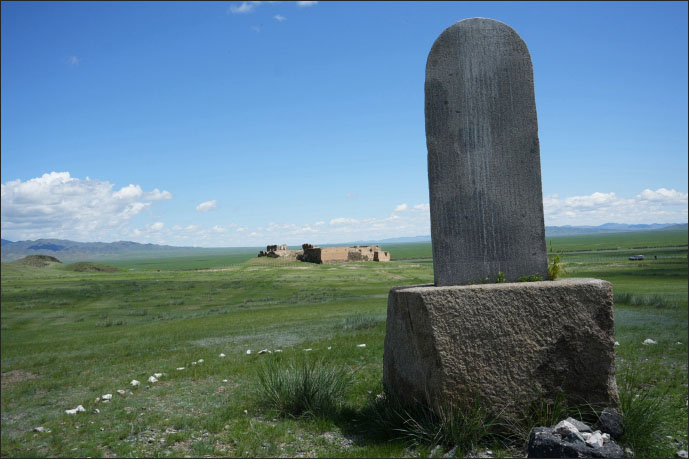
Figure 2. The Čaγan Baiśing stele with Čaγan Baiśing ruins behind. Image taken by the author.
Together with two other much shorter rock inscriptions in a nearby region, the inscriptions on this stele are all that has been left behind by Čoγtu Qongtaiǰi, the so called “enemy of the dharma endowed with ten defects.” As it will become apparent in the translation of his stele and the discussion of its contents in this article, the story of Čoγtu Qongtaiǰi was more complex than we have been led to believe by the extant historiographical sources that have passed down to us.
To set the scene for the stele and its contextualization, this article will begin by introducing Čoγtu Qongtaiǰi as he is presented in the various Tibetan and Mongolian historiographical sources that are known to us. The next section of this article will make an enquiry into the usage of Tibetan and Mongolian for this stele by examining and comparing the contents of both sides of the stele. I will highlight the difference between the two sides of the stele in terms of content, and the extent of the information contained within to raise questions about the possible audiences whom the different sides of the stele would have been accessible for. In the last section of this article, I will explore the historiographical implications of the stele’s contents in the context of religion and politics in Inner Asia during the dusk of the Mongol power and the dawn of the Qing.
1. The Bald Qaγan of the Qalqa
Čoγtu who had the wrong view of opposing the teachings of the second Buddha Tsongkhapa arrived in Tibet together with his large army. Čoγtu father and son possessed the ten defects [of the enemy of the dharma] and deserved to be destroyed.[4]
The ten defects of the enemy of the dharma are as follows: 1) acting aggressively towards spiritual friends, 2) degrading the secret mantra, 3) harming one’s peers (sibling/brothers), 4) destroying/degenerating the dharma, 5) destroying hermitages, 6) harming everyone, 7) being an obstacle to bodhisattvas/enlightenment, 8) giving into one’s desire, 9) destroying virtue, and 10) breaking one’s samaya.[5] The passage above is found in the writings of the First Qalqa Dzaya Paṇḍita (1642–1715), who was one of the most prolific polymaths from Qalqa Mongolia, the very region that Čoγtu Qongtaiǰi was also from. Thus, according to this passage, Čoγtu Qontaiǰi was such a threat to the Buddhist tradition.
There is very little written about the life and deeds of Čoγtu Qongtaiǰi in the Mongolian and Tibetan language historical sources from the seventeenth century.[6] What we do know about Čoγtu Taiǰi’s life is as follows: He was one of the nephews of Abadai Qan of the Qalqa Mongols. He occupied the land near the Tuγula River in today’s Tüśiyeü Qan banner in Mongolia. He was one of the few Činggisid nobility who remained loyal to the last Čaqar ruler Ligden Qutugtu Qaγan until the end of the Northern Yuan following Ligden’s death in 1632. He fell out with the other Qalqa nobility and, sometime before 1630, for uncertain reasons, he left Qalqa with forty thousand soldiers, taking over the territories in Kökenür from Altan Qan’s descendants. There he settled, built a fortress, mined for salt peter, and was known as The Bald Qan of Kökenür until his death in 1637 following his defeat by the Oirad Güśi Qan and his army.
Due to the vast majority of historiographical sources that are available to us today being the works of later Geluk authors during the height of the Qing period, many of the figures who were not part of the wider Geluk or Qing inner circles were, at best, often exaggeratedly vilified or simply omitted from history. Like the last Yuan Qaγan Ligdan who despite his deep engagement and support of Tibetan Buddhism is remembered as a villain and destroyer of the Buddhist tradition, Čoγtu Qongtaiǰi represents another such figure.[7]
In a similar vein to Dzaya Paṇḍita’s description of Čoγtu Qongtaiǰi above, all extant Tibetan and Mongolian language sources that do mention him also depict him as “an evil person” who possessed the “ten defects the enemy of the dharma.”[8] For example, the Fifth Dalai Lama writes in his autobiography: “The leader Čoγtu pretended that he had faith in the Kagyü as well as an interest in Chinese policy. [In reality] he excluded himself from the Buddhist faith and let himself be influenced by demons.”[9]
The Dalai Lama and Dzaya Paṇḍita’s descriptions represent some of the earliest written sources for the events leading up to the enthronement of the Fifth Dalai Lama as the supreme religious and secular leader of Tibet in 1642. They have formed the basis for many later Tibetan and Mongolian historiographies. For example, Sumpa Khenpo writes in the eighteenth century:
In the dog year, at the time when inner disputes were being instigated by the evil Čoγtu Qongtaiǰi, the Qalqa nobilities exiled him. He then came to Kökenür and conquered the region and became famed as the Bald Qan of Kökenür.[10]
If we turn to some of the key Mongolian language historical works covering the period, they equally vilify Čoγtu Qongtaiǰi. In Raśiphuntsog’s Bolor Toli, we find:
Qalqa Čoγtu Qongtaiǰi was a villainous individual who occupied the mountains by Kökenür together with forty thousand soldiers. Ligdan Qan allied with him. They also allied with the King of Beri who disliked Buddhism. Thus Ligdan Qan, the King of Tsang, the King of Beri, and Čoγtu Qongtaiǰi went about damaging the yellow hat tradition [of Tibetan Buddhism].[11]
What these works have in common is their authorship of Geluk monk-scholars writing in a period after the Fifth Dalai Lama, the Ganden Phodrang government prevailed after the demise of Čoγtu Qongtaiǰi, the King of Tsang, the King of Beri and their various allies.
What is interesting is that even in the earlier part of the Fifth Dalai Lama’s autobiography before the clash between Čoγtu Qongtaiǰi, Ligdan Qaγan, and the pro-Geluk factions, the reference to Čoγtu Qongtaiǰi is quite the contrary. In his earliest reference to Čoγtu Qongtaiǰi in the early months of 1634, the Fifth Dalai Lama writes:
Čoγtu sent his minister Thaichin to distribute donations generously to all high lamas, irrespective of their religious schools. I also received a gift that was to be my share coming from him.[12]
This entry suggests that Čoγtu Qongtaiǰi was in fact paying his respects to lamas of Tibetan Buddhist schools despite their sectarian affiliation. Digging through earlier Mongolian works that predate Čoγtu Qongtaiǰi’s arrival in Kökenür, there is no reference to be found of his so called “anti-Buddhist” or “violent ways.” In many of these historical works, Čoγtu Qongtaiǰi is listed alongside the Činggisid ancestors and descendants of the Činggisid bloodline.[13] These lists are almost identical to one another. Summarized here is the section covering Čoγtu Qongtaiǰi’s immediate elders and offspring:
Tümenken Čoγtu Qongtaiǰi was the son of Baqarai Qośiγuči, the fifth son of Onoqu Üiǰen Noyon. Čoγtu Qongtaiǰi’s sons were Arsalang Qungtaiǰi of Očir banner, Ratna Erdene, Lyanhua Sečen Daičing, Karma Juin Jagan, and Asral Erkh Daičing.[14]
Of his sons, we know that Arsalang went with him to Tibet. If Čoγtu was truly an enemy of Buddhism, then it would seem odd that three of his sons had names imbued with Buddhist meaning. Ratna Erdene means “precious jewel,” Lyanhua Sečen means “wise lotus,” Karma Juγin Jaγan means “Elephant of the Karma Kagyü.” Thus, the names he gave to his children are also suggestive of his interest in Buddhism rather than animosity against it.
Many scholars have noted in passing that Čoγtu Qongtaiǰi was aligned with Ligdan Qan not only in terms of their political aspirations to establish again a united Mongol state, but also regarding their preference for religious affiliations. It is also said that Ligdan Qan and Čoγtu Qongtaiǰi were supporters of either the Sakya or Karma Kagyü tradition, or both often simply referred to by the Mongol sources as the “red tradition(s).”[15] Furthermore, amongst the texts found from the Mongolian translations of the Kangyur commissioned by Ligdan Qan, there are several texts that mention Čoγtu Qongtaiǰi as the patron in the colophon. For example, Life Story of Milarepa and the Songs of Milarepa, the founder of the Kagyü tradition of Tibetan Buddhism were translated by Śiregetü Güśi Čöji in 1618 following the request of Čoγtu Qongtaiǰi and his mother Queen Ching Taihou. The translator’s colophon to the Life of Milarepa written by Śiregetü Čöji paints a saintly visage of the mother and son:
Because the namthar (rnam thar) of this holy one [Milarepa], was previously not renowned in these Northern Mongol lands, it would be beneficial for the spread the Buddhist teachings in this central country if it was translated.” Thus it was proclaimed by the meritorious Queen Ching Taihou, who is known by all to have abandoned all deluded activities, and her son Čoγtu Qongtaiǰi, who is renowned as one endowed with omniscient wisdom, who has obtained the realization beyond words and acts incomprehensibly for the sake of the dharma. With pure intention and diligence, the two of them requested for this text to be translated so that the translation of this precious namthar can benefit all sentient beings.[16]
Čoγtu Qongtaiǰi and his mother requesting for these key Kagyü texts to be translated into Mongolian for the sake of benefiting the Buddhist teachings seem rather absurd if they were indeed “enemies of the dharma” and “destroyers of Buddhism.” These translations by Śiregetü Čöji were printed in the 1800s during the Qing period and were widely circulated amongst monasteries right up to the 20th century. On the eve of the cultural revolution, the cham (’cham) dance of Milarepa based on these translations was still being performed in Naiman Aimag in Aru Qorčin banner of Inner Mongolia.[17]
If we trace the mother and son to their homeland in Qalqa, evidence among the lonely ruins of Čaγan Baiśing provide further indications of their life and activities. On the banks of the Tuγula River in Tüśiyëtü Qan Aimag, or what is today Daśinčilen sum of Bulγan Aimag in Qalqa Mongolia, we find the ruins of a site known as Čaγan Baiśing, “The White Palace.” The remains of several large high walled buildings, Buddhist monasteries, and a lone stupa are all that remains of what was once one of six large monastic sites that were established by Čoγtu Qongtaiǰi and his mother in Northern Mongolia between 1601–1617. A two-sided Tibetan and Mongolian language stele once stood in the center of the main temple courtyard. If this stele had not been rescued, then one of the few pieces of evidence contemporary to Čoγtu Qongtaiǰi that can defend him against the profanities claimed against him after his demise would have been completely lost to history.
2. The Stele
Today, the stele stands about half a kilometer outside of the Čaγan Baiśing ruins. The rock for the stele is hewn from the mountains nearby and stands about two meters tall. All signs indicate that originally, the stele stood atop a stone tortoise like many other steles we find from the sixteenth and seventeenth centuries across Northern Mongolia. The Mongolian side [Fig. 3] starts off with four horizontal rows of mantras in Tibetan and is followed by twenty-three vertical lines of classical Mongolian script verses with between four to five lines in each row. The colophon for the Mongolian side is contained in its own section at the bottom of the stele and appears in twenty rows with a word or two in each line. The Tibetan side [Fig. 4] starts off with three rows of mantras and is followed by has forty-five horizontal rows of text with between three and four lines of verse for each row. The last two lines consist of the colophon. The colophons of the two sides are completely different.
The Mongolian colophon tells us that the Mongolian side of the stele’s message was written by two figures, Mergen Obaśi Gelek and Qorlosun Aldarśiγsan Čindamuni Obaśi and was carved onto the rock face by a skilled Chinese stone mason. As for the Tibetan side, the main text is recorded to have been written down by Paṇḍita Śiregetü Güśi Čöji and later written out by Genyen Karma Rikzin Drakpa Norbu (rig ’dzin drag pa nor bu, dates unknown) before it was carved onto the rock by two expert Chinese stone masons. This must have been the very same Śiregetü Güśi Čöji who came to Kökeqota in 1581 and came to be highly regarded by many of the southern and northern Mongol groups and spent his life travelling extensively among his patrons.[18] He was renowned as an exemplary translator who was responsible for a number of Mongolian translations of Tibetan texts from the early 17th century including the Life of Milarepa and the Mani Kabum by the request of Čoγtu Qongtaiǰi while he was in Qalqa Mongolia.[19]
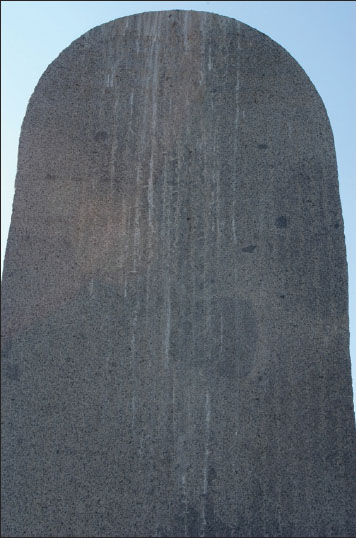
Figure 3. Mongolian side of stele.
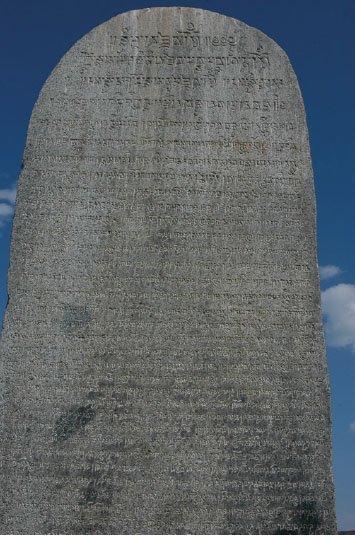
Figure 4. Tibetan side of stele.
Despite the statement on the Tibetan side of the stele that states “a rock was hacked which had identical messages on both sides,” the two sides are completely different and contain different information about Čoγtu Qongtaiǰi, his mother, their activities and the circumstances surrounding the erection of the stele. Neither the Tibetan nor the Mongolian colophon mention any matters of translation, which indicates that the two sides were always composed as separate texts designed for different audiences. However, the information regarding what this monastery was, how, where, and when it was constructed, as well as other crucial information about Čoγtu Qongtaiǰi and the other figures who were involved in the composition of its sides are spread across the two sides. If read separately, the information is incomplete. As it will become more apparent with the translation of the stele’s facades presented below, the two sides come together to make a singular whole.
3. The Mongolian Side of the Čaγan Baiśing Stele
Although the main subject of this article is Tibetan literature, because this is a bilingual stele that claims to contain the same message on both sides, it is important to discuss both the sides equally in this discussion. Especially given that Mongolian and foreign scholars who have studied the Mongolian side of the stele, in echo of the stele’s own proclamation, have maintained that the messages on either side are identical. Consequently, the contents of the Tibetan façade have remained hidden behind the veil of the Mongolian. However, as it shall be revealed below, the two sides are far from identical.
The contents of the Mongolian side can be summarized as follows. The first few lines contain mantras of buddhas and bodhisattvas written in Tibetan script. The mantras as they appear in order are those of Amitābha, Avalokiteśvara, Avalokiteśvara Hayagrīva, and Padmasambhava (repeated three times). The Mongolian text begins with verses of reverence to the Lama, Buddha, Dharma, Sangha, Vajradhara, and Činggis Qaγan. Then the text transitions to prose. The prose links Čoγtu Qongtaiǰi and his mother’s ancestral lineage to Činggis Qaγan, as well as Abadai Qan and his elder brother Kündülüng Čükegür who played key roles in establishing the Geluk tradition in Qalqa Mongolia during the sixteenth and seventeenth centuries. Following this, the text expounds the mother and son’s motivations for benefiting the Buddhist teachings and sentient beings. The prose text concludes by providing the information for six large monasteries headed by the Sedkigși Ügei Čindamuni Süme, “The Inconceivable Wish Fulfilling Monastery,” that the mother and son built between 1601 and 1617. The remainder of the text returns to verse form and consists of a series of aspirational prayers for:
•Obtaining the precious human life, freedoms, and advantages.
•Encountering authentic teachers, keeping one’s precepts and samayas, and training in the six pāramitās.
•Generation stage of Hevajra, defeating the four māras, and accomplishing the eight siddhis.
•Completion stage of the six yogas of Naropa and the māhamudrā.
•Aspirational prayer of Vajrapāṇi.
•Aspirational prayer of Naropa.
•Aspirational prayer of the buddhas, bodhisattvas, māhasiddhas, and the sixteen arhats.
•Aspirational prayer of the sun.
•Aspirational verses of the four immeasurables.
The text concludes with the individuals responsible for composing and inscribing the Mongolian side of the stele, namely, Mergen Obaśi Geleg, Qorlosun Aldarśigsan Čindamuni Obaśi, and a skilled Chinese stone mason. Underneath the main text, there is an additional insert in a different style of writing that is much rougher than the main body of the stele that was likely carved by the individuals who partook in the construction work for the monasteries who did so for the sake of merit making. They were Gerigüdün Bintu blacksmith, Qorlosun Čimiγtu blacksmith, and four builders headed by Rinčendon Čingir Sanggye and Quluči Külüg Büimen.
The Mongolian side does not contain detailed information about the construction of the monastery or the contents of its temples, and the section which relates the building of the monastery and the section relating the religious activities of Čoγtu Qongtaiǰi are quite short. It does, however, tell us when the monastery was completed, which is information that is lacking from the Tibetan side. For the most part, the Mongolian text consists of a series of aspirational prayers relating to the Kagyü tradition and its major lineage holders and important practices and teachings.
The Translation of the Mongolian Inscription of the Čaγan Baiśing Stele
༄༅ om a mi de bha a yu si dhi hūm. om ma ni pad me hūm.
hri padma takri ta badzra gro ta hā ya gri ba hū lu hū lu hūm phat.
om ā hūm ༔ badzra gū ru padma si dhi hūm ༔ om ā hūm ༔ badzra gū ru padma si dhi hūm ༔ om ā hūm ༔ badzra gū ru padma si dhi hūm ༔
༄ Homage to the most extraordinary dharma!
The true nature of the body, speech, and mind
Of the Buddhas of the three times
Completely gone beyond cause and effect
I prostrate to the root of the precious teachings/speech.
Lama, Buddha, Dharma, Sangha
The glorious lama Vajradhāra
The lama venerated in the three realms,
I praise and prostrate to my lama.
In the numerous asaṃkhyeya kalpas,[20]
Having accumulated the vast merits
Was born with a magnificent body in this Mongol land of ours
As the Qaγan of the ten directions (i.e., Činggis Qaγan).
After thirty-one generations had passed since that lord Činggis Qaγan, there was [the one known as] Dayan Qaγan who glorified and made his ancestral lineage flourish. His queen was Jimisgen, the most beautiful. She had two sons, the younger of whom was Jalyir Qongtaiǰi, who became the lord of the Qalqa Tümen of Qangaiqang. He had seven sons, the second of whom had five sons. Uyiǰeng Taiǰi had had six sons, Očir Qan, Daičing, Yaltang, Čükegür, Qośiguči, and Bodisong. From these the two who were like the sun and the moon, [Abadai] Qan and Čükegür[21] brought tremendous benefit to the world and the teachings. During their virtuous and prosperous reign, the Čing Biśireltü Sain Madi Taigal queen of Qośiguči Taiǰi, and her son Čoγtu Qongtaiǰi, the mother and son, considered the benefit of countless sentient beings. West of the lush plains of the Tuγula River, there lies the slopes of the mountain named Qaltur-yin Jﬞirühen (the heart of Qaltur). From the fifteenth day of the blue month of the year of the iron ox (1601) for seventeen years, they (i.e. mother and son) built six monasteries starting with the Sedkiśi Ügei Čindamuni Süme, which was completed in the first blue summer month of the fire snake year (1617).
To virtuous parents in favorable places
Complete with the ten advantages
Having perfected the perfection of diligence
May I obtain the most blessed human body.
May I meet with the peerless empowerment lineage
Pleasing it with the three venerations[22] without doubt or separation
Keeping appropriate the samaya and other vows intact
May I live my entire life in accordance with the six pāramitās.
The six sections of the mandala of the generation stage of Hevajra
Faultlessly combines the mindstream with that of the yidam indivisibly
Always being mindful without neglect of the four māras[23]
Starting with the mighty ability to traverse the sky, may I accomplish the highest eight siddhis.
At the completion stage of the six yogas of Naropa and māhamudrā,
May I familiarize the methods of the precious drop, wind, and the channels
May the ten signs and the eight dissolutions[24] clearly manifest
May I accomplish all the peerless siddhis.
Māhabodhisattva Vajrapāṇi, King of the wrathful ones,
In the way he acted since beginningless time,
For the sake of myself and others, the sinful beings
In that way, may I too help all sentient beings.
The renowned holy one paṇḍita Naropa
In the way he acted throughout the numerous asaṃkhyeya kalpas
For the sake of all the beings of the ten directions
May I also act forever following their model.
The truly perfected buddhas starting with the great Krakucchaṃda[25]
And the bodhisattvas of the ten directions headed by Maitreya
And the māhasiddhas and the arhats
May their accomplishment be steadfast for the sake of others.
The sun which shines everywhere
Illuminates the suffering of sheer darkness
Yet does not remain in any of the four continents
In that way may I too benefit countless beings.
May all beings possess happiness and the causes of happiness
May they be free from suffering and the causes of suffering
May they never be separate from happiness without suffering
May they come to rest in the boundless equanimity free from attachment to loved ones and hatred of others.
Mergen Obaśi Gelek, Qorlosun Aldarśiγsan Čindamuni Obaśi, and a skilled Chinese stone mason wrote and carved this.
Mangalam Bhavantu!
༄ Those who gave their strength for the sake of erecting these six monasteries are
Gerigüdün Bintu blacksmith, Qorlosun Čimiγtu blacksmith, as well as four builders headed by Rinchendon Čingir Sanggye and Qoloči Qülüg Büimen.
The Mongolian side of the stele is predominantly made up of aspirational prayers which indicate that they were intended to be read by the Mongolian nobility who would have been the primary audience for this side. Throughout the history of the Mongolian people, literacy was the privilege of the nobility and later the monastic scholars. Therefore, the Mongolian text of this stele marking the completion of the six monasteries built by Čoγtu Qongtaiǰi is intended for a certain elite class of Mongolians who were literate in Mongolian and were also able to comprehend and engage with the complex high tantric practices and concepts outlined in these aspirational verses.
The deities such as Hevajra and practices such as the six yogas of Naropa and the māhamudrā that were referred to also indicate Kagyü affiliations, which aligns with the “red hat” placed over Čoγtu Qongtaiǰi’s and his ally Ligdan Qaγan’s heads by Mongolian and foreign scholars over the years. The generation stage and completion stage practices being described are by no means entry level tantric endeavors. Here, the probability rises that Mongol lay nobility continued to practice high yoga tantra practices from the times of Qubilai Qaγan throughout the so-called Mongol “dark period,” right up to the dawn of the Geluk dominancy across the steppe.
Given the reference to the Kagyü practices and teachings, the six monasteries built between 1601 and 1617 referred to in the Mongolian text are unlikely Geluk monasteries, meaning that there were Kagyü monasteries in Mongolian lands even after the large Geluk monastic institutions such as Erdeni Juu and Yehe Juu were built in the last decade of the 16th century. The Mongolian façade of the stele does not provide much more information apart from the date of their construction, but if we turn to the Tibetan side, the picture becomes more elaborate.
4. The Tibetan Side of the Čaγan Baiśing Stele
The Tibetan side of the stele starts with the mantras of Vajrasattva, Vajrapāni, and Acala. Then the text in verse starts off with a summarized history of the spread of Buddhism from India to Tibet, and thereon to Mongolia, whilst paying homage to the Buddha, Padmasambhava, and Činggis Qaγan. The next section is dedicated to narrating a Buddhicized version of the history of the Mongol and Yuan empire down to the time of Dayan Qan in the fifteenth century, which is reminiscent of, but predating, later seventeenth century historical works by Mongolian and Tibetan Geluk writers. Compared to the Mongolian side, this section is very detailed, depicting at some length the succession of Mongol rulers as dharmarājas ruling the realm through skillful means, and the qoyar yosun (two systems), which makes this inscription one of the earliest textual references to the qoyar yosun.[26] In this vein, Dayan Qan is lauded, not for uniting the Mongols into some semblance of an empire as he is often depicted, but for dispelling the confusion about different Buddhist texts, traditions, and methods of practice, and for “taming the beings” as a Buddhist King. Next, the descendants of Dayan Qan down to Čoγtu Taiǰi and his mother Ching Taihou are listed. Unlike those who detested the dharma, the mother and son are described as people who “acted extensively out of faith [for the Dharma],” after which their “great deeds for the sake of the dharma” are outlined in more detail.
What were these deeds? They primarily concern the details of the six great monasteries that were constructed at different sites throughout Qalqa Mongolia. As for the name of one of these monastery complexes, the stele’s Tibetan side tells us that Čoγtu Taiǰi and his mother Čing Taihou chose a place that was endowed with all the marks of an auspicious land that are stereotypical for a site that is appropriate to build a monastery on, and in the center, they built a great monastery and named it Samyé. Samyé was of course the name given to the first Buddhist monastery built in Tibet by King Trisong Detsen during the eighth century. If the Jokhang in Lhasa is sacred as the home to the oldest Buddhist statue to be brought to Tibet, then Samyé holds the position as the oldest, most sacred of all monasteries in Tibet. Not only did Samyé mark the beginning of monasticism and institutionalized Buddhism in Tibet, but it was also announced to the world that it was King Trisong Detsen who was responsible for bringing Buddhism to Tibet and ruling the realm according to the dharma; Samyé was the very embodiment of the divine rulership of the King of Tibet. Thus, like Altan Qan recreating the Jokhang and the Jowo as the center of his realm in Kökeqota as the embodiment of his power and divine status, Čoγtu Taiǰi naming his monastery Samyé again follows in the footsteps of Altan Qan, Abadai Qan, and the lords of the Ordus in initiating oneself as an authentic Buddhist ruler of a realm. Čoγtu Taiǰi was following suit and adopting the world-building model that Altan Qan had initiated. But unlike Altan Qan and those who followed suit in his pursuit of the Dalai Lama and the Geluk school as their source of the Buddhist legitimization, Čoγtu Taiǰi used Altan Qan’s model to court a different Tibetan Buddhist school.
Although the Tibetan text does not provide the dates of construction, it does describe in detail the monasteries, their exact location, the various temples of the site at Čaγan Baiśing, their religious supports such as the statues of buddhas and bodhisattvas, and the texts kept within. It records Čoγtu Qongtaiǰi as the one who personally designed the temples and gave the instructions for how to arrange the religious supports and sacred objects inside the temples. The actual proclamation made by Čoγtu Qongtaiǰi is preserved on the Tibetan side of the stele. This begs the question of what language Čoγtu Qongtaiǰi originally spoke the proclamation in. It is unlikely that he was literate in Tibetan or was able to speak Tibetan, so the likelihood of this proclamation being made originally in Tibetan is very low. It can be assumed that he would have made the proclamation in Mongolian, and it was, as it is recorded on the stele, originally recorded in Mongolian by Śiregetü Güśi Čöji, who translated it into Tibetan before having it inscribed onto the stele. This would explain why the record of Śiregetü Güśi Čöji recording Čogtü Qongtaiǰi’s proclamation is found earlier on in the stele’s Tibetan text than the final colophon.
The descriptions of the monasteries and their supports are referred to as an “account of how the religious supports were erected, as well as the explanation of places of interest for pilgrims and the arrangements of the temples,” suggesting it was intended for a Tibetan literate audience who would visit the site. In the early 17th century, such as audience in Northern Qalqa Mongolia would be restricted to monastic and religious noble elites. Given the Kagyü leanings of its patron, there must have been Kagyü supporters in Northern Mongolia in the 17th century at least until the destruction of these sites by the forces of the Jungar Galdan Bośogtu Qan (1644–1697) not long after he invaded Qalqa lands 1688.
Last of all, the final colophon reads “inscribed onto this rock by Genyen Karma Rikzin Drakpa Norbu and two expert Chinese stonemasons.” Although difficult to guess whether he was Tibetan or Mongolian, this Genyen Karma Rikzin Drakpa Norbu stakes an undeniable Kagyü claim on this site in rock to face the test of time and the elements long after Čoγtu Qongtaiǰi perished, and his monasteries were destroyed.
Here follows a full translation of the Tibetan facade of the stele. As it will become apparent, the activities of Čoγtu Qongtaiǰi and his mother are far from those who could be labelled as possessing “the ten defects of the enemy of the dharma” who intended to destroy Buddhism.
The Translation of the Tibetan Side of the Čaγan Baiśing Stele
༄༅ Om badzra sa twa hūm.
Om ni lam bha ra bha ra badzra pa ni hri ta ya ma hā krō ta sa twa hūm phat.
Om badzra tsanta ma hā rokya na hūm phat.
༄ ༈ Born into the Śākya clan through skillful means and compassion,
Beyond the abilities of any other, conquered the armies of māra,
To the one with a shining body like a golden mountain,
I pay homage at the feet of the king of the Śākyas.
He who extensively sees all beings, places, and phenomena,
Endowed with compassion of the deeds that accomplish, listen, and clarify,
The sole ornament of the scholars and siddhas of Tibet,
I pay homage to the miraculous emanation body (i.e. Padmasambhava).
May the roots of the four activities of the awakened body be steadfast!
May the foliage of the immeasurable four aspects spread throughout the ten directions!
The victorious siddha lama, supreme in the four continents, whose true essence is the same as the ocean of innumerable jīnas due to the spontaneously arising fruits of the four aspects of the awakened activities. He turned the great wheel of dharma in the land in the north of the stainless Bodhgaya, the snow-covered realm of Tibet. There, the teachings of the victorious one were spread extensively.
From there, gradually, in the land to its north, in accordance with the prophecies proclaimed again and again, the son of the gods Činggis Qaγan was born. He was born in the belly of this expansive and rich filled land in the north for the sake of the teachings of the Buddha to flourish there. Through his command and strength, he brought the sentient beings which are hard to tame like mu (dmu) demons and wild deer under the control. By beating the great drum of the law of the two systems, he properly established the victory banner of the teachings. By conquering all, he worked to establish happiness, wellbeing, and glory. Since then, for the next fifteen royal generations, the sun of the teachings rose in the sky, the white smile of the great grove of lotus flowers of the teachings of the Buddha blossomed, the fifty-six assemblies of the fortunate beings arose and were bestowed with liberties and love, and the ocean of virtuous accumulations thoroughly expanded.
Particularly, amongst those Dharma kings [that followed], the dharma king named Sechen Chögyal (i.e. Qubilai Qaγan) honored the teachings of the victorious one as his crown ornament and invited numerous translators, paṇḍitas, and bodhisattvas who came to translate many teachings and the dharma of the victorious one. Consequently, the minds and views of the kings and ministers were turned towards the dharma and the kingdom was sustained properly in accordance with the dharma. Because the teachings of the Buddha prospered, peace was sustained.
Many generations of dharma kings have passed since the time of the king named Činggis. They conquered and established [their realms] through wholesome deeds. Their subjects abandoned unwholesome activities and acted in accordance with the happiness and wellbeing [of self and others]. The realm was properly guarded in accordance with the dharma. The sun of the dharma rose, illuminating everything. The darkness was conquered and the virtuous activities radiated. The teachings of the dharma king prospered, and the white virtuous deeds of the highest perfections were accomplished.
Then the kingdom of the blessed kings was seized. During the reign of the unfortunate kings the dharma declined. Since then, many generations have passed. At the time when a lot of confusion between many great texts was being made, many disputes between method and debate occurred and people were creating their own branches. When the time had arrived for those sentient beings to be tamed, a King named Dayan[27] was born who endeavored to conquer and to establish happiness. He beat the great golden drum in the kingdom and acted to set the kingdom in accordance with the system.
One of the sons of Dayan Qan who was the lord of men, was named Geresenǰi J̌alair Taiǰi.[28] He established himself in the great land known as Qalqa and conquered lands of the outer regions. His son was named Üijen Taiǰi.[29] His son was Dorjé Gyalpo[30] and his brother was Kośuči Taiǰi. That Taiǰi’s queen was Ching Taihou and her son was Čoγtu Qongtaiǰi. These two, the mother and son, the two acted extensively out of faith [towards the dharma].
Especially, their great deeds for the sake of the dharma are as follows. The land where they built great monasteries was a realm underneath the sky possessing the markings of the eight-spoked wheel. The earth was a stage that displayed the eight- petaled lotus. The surroundings were circled by the eight auspicious symbols. In such a place which possessed the supreme treasuries of the Nāga King, they built a great monastery called Samyé. Behind the monastery, stands a mountain called Qaltur. The plains to the east of the monastery were endowed with marvelous qualities and decorated with six high peaks. From the mountain known as Borqan Qaldun flows the river called Tugula down to the area to the north of the plain that possesses marvelous qualities. There they built a temple that had a lotus lake in front and a vast space in front for rituals, funerary rites, and other bustling activities. There, a rock was hacked which had identical messages on both sides.
Amongst the crowds gathered there, he [i.e. Čoγtu Qongtaiǰi] proclaimed:
“Inside the great central temple that is built atop this land endowed with the complete attributes, erect statues of the buddhas of the three times and the eight retinue bodhisattvas. In the temple on the right, properly erect a statue of the victorious Maitreya and from the center progressively to the right, inside each temple erect statues of Guhyasamāja, Mañjuvajra, and the Buddha Vajradhara. In front of the central temple, build two small temples, and inside erect statues of Avalokiteśvara, the two Tāras, and a statue of Vajrabhairava. As for how the supports of the speech that should be enshrined inside, they are as follows. The Prajnāpāramitā in twelve volumes which is the combined essence of the 84000 teachings of the Buddha. Place many texts with the teachings of the victorious one inside.”
This is the account of how the religious supports were erected and the explanation of places of interest for pilgrims and the arrangements of the temples. As for this stone inscription which contains the words of faith of the mother and son, it was composed and properly written down by the Śākya monk Śrīśilasvarava, also known in this Northern land of Qalqa as Paṇḍita Śiregetü Čöji.
By the power of the godson who is like the ocean of wellbeing,
May the mother and son together with the royal lineage,
Be endowed with long life, good health, wellbeing, and happiness,
May favorable conditions come their way and may their wishes be fulfilled according to the dharma.
Ching Taihou and Čoγtu Qongtaiǰi’s, chief sons, sons, daughters, and ministers,
May they be victorious over all unfavorable matters forever.
May they enjoy good fortune and prosperity in all lifetimes.
May they quickly attain the state of ultimate Buddhahood.
Inscribed onto this rock by Genyen Karma Rigdzin Dragpa Norbu and two expert Chinese stonemasons.
May it be virtuous! May it be wonderful! May it be auspicious!
The Tibetan side of the stele not only preserves information about possibly the last and only known Kagyü monastic sites in Mongolian regions but also acts as the only surviving evidence for Čoγtu Qongtaiǰi’s identity and intentions. It is the proclamation of a proclamation to stand in place of the missing historiographies that can speak on behalf of those who could not.
The curious question of why his proclamation was only recorded and inscribed in Tibetan and not Mongolian remains a puzzle. What we can deduce is that the Tibetan side of the stele was intended for pilgrims and monastics who would primarily read Tibetan. As the text points out, it is a travel guide for pilgrims and visitors to the temple and it describes the religious supports and “places of interest for pilgrims and the arrangement of the temples”, which is reminiscent of more extensive travel guide (lam yig) or pilgrimage guide (gnas yig) literature. These genres of Tibetan Buddhist literature have a long history and were primarily composed for the religious community. There exist versions like this inscribed on steles at large monasteries as well as those in manuscript or block printed form.[31] One likelihood is that the information contained in the Tibetan text which concerns the meditation deities and the religious texts enshrined at the monastery was more relevant for a monastic audience and was not included on the Mongolian side simply because it was not as important for those who were literate in Mongolian, the nobility who would visit the religious site. If they were Mongolian monastics, then they would naturally be fluent in Tibetan.
Čoγtu Qongtaiǰi’s recorded proclamation could be interpreted as his statement was originally made in Tibetan, which at first glance seems rather unlikely. It is easy to opt for the simpler answer that Śiregetü Čöji translated the Mongolian into Tibetan to be inscribed on the stele. But one must ask, why then was it then not preserved in the original language on the Mongolian side of the Stele? The possibility of Čoγtu Qongtaiǰi’s literacy in Tibetan cannot be completely ruled out. After all, there was several lay Mongolian nobilities that we do know of who possessed high level of Tibetan literacy during the 17th century. Individuals such as Sagang Sečen, the author of the famous Erdeni-yin Tobchi, Qutugtai Sečen Qongtaiǰi, and so forth who were advocates of the Geluk tradition. A sectarian difference is not reason enough to conclude that a Kagyü supporting Mongolian nobility could not be literate in Tibetan.
In the mountains close to Čaγan Baiśing, there are other clues etched in stone that provide further evidence. In the mountains of Čečerlig in Qanggaiqang, there are two rock inscriptions attributed to Čoγtu Qongtaiǰi. They are known as the Great Inscription and the Little Inscription.[32] The Greater Inscription contains a poem exclaimed out aloud by Čoγtu Qongtaiǰi in 1621 which was inscribed onto the rock face four years later in 1624. The Lesser Inscription is a short prayer for Ligdan Qaγan and Čogtü Qongtaiǰi’s aunt. As well as providing important information about Čoγtu Qongtaiǰi’s dates of departure from Qalqa Mongolia,[33] the verses of both of these two poems align with the Buddhist kāvya style works and is imbedded with references to Buddhist concepts, again indicative of Čoγtu Qongtaiǰi’s deep familiarity with Buddhist literary conventions. This aligns with the folk memory of Čoγtu Qongtaiǰi as a prolific poet in the oral traditions of the local Mongols from his homeland, a memory that lives on to this day.
Despite the construction of monasteries and cities in Qalqa Mongolia, Čoγtu Qongtaiǰi left his homeland for Kökenür where he would later perish. The reason for his departure is disputed, some sources say it was because he fell out with the Qalqa nobilities over matters of politics or faith, some sources argue that he left to join forces with Ligdan Qan to destroy the Buddhist tradition and take over Tibet. But these are all later Geluk orientated sources that postdate the deaths of Čoγtu Qongtaiǰi and Ligdan Qan, all intent on a demonized portrayal of the pair. The literary and material evidence discussed thus far shows that these two figures were far from being enemies or destroyers of the Buddhist tradition but rather, ardent advocators, albeit Kagyü and not Geluk. Furthermore, it was more likely that Čoγtu Qongtaiǰi arrived in Tibetan lands in Kökenür before Ligdan Qan.
The clues left behind on rock, when strung together tells Čoγtu Qongtaiǰi’s life story leading up to his departure from his homeland. Allying himself with the last Činggisid Qan of the Northern Yuan, he built cities that were reminiscent of the great cities of the Yuan period and continued to practice and venerate the Buddhist traditions that his ancestors patronized. All of this must have made him rather unpopular amongst the other Mongolian nobility in Qalqa who were starting to ally themselves with the Manchus and following Altan Qan and Abadai Qans examples, were starting to advocate for the Geluk tradition that was spreading like wildfire amongst the Mongols. Čoγtu Qongtaiǰi, after delivering his heartbroken poem atop the mountains of Qanggaiqang in 1621, mostly likely left for Kökenür in the following water dog year (1622). Ligdan Qaγan’s flight West in 1632 was therefore to join his only remaining ally Čoγtu Qongtaiǰi after losing his territories to Qongtaiǰi, not to attack Tibet and destroy the Geluk tradition.
Local legends from the Kökenür Mongols tell of his life there as the Bald Qan of Kökenür, who having come from the Qalqa lands settled near the banks of the lake and built a great fortressed city called Sorunǰin Qota, “Magnet City” from mud and stone, established the usage of Mongolian language in the region, set up centers of trade, supported Buddhist institutions, dug mines for magnetic and iron ore in the mountains, mixed gunpowder, forged canons, befriended the Tsang Desi, and the King of Beri. According to these legends, all Čoγtu Qongtaiǰi’s endeavors were brought to an end after a siege by the Oirad Mongols lead by Güśi Qan that is said to have lasted six years. It is said that the ruins of his great city and their watchtowers can still be seen today. Tibetan and Mongolian language historical sources such as the writings of the Fifth Dalai Lama indeed verify his association with the two Tibetan kings, and his support of Buddhist hierarchs through offerings and donations regardless of tradition, but nothing is mentioned of his contribution to the local infrastructure, commerce, and society. All that can be gleaned from the mainstream historiographical material is that after Čoγtu Qongtaiǰi and his army of forty-thousand soldiers were defeated by Güśi Qan and his significantly smaller army of ten thousand Oirad soldiers, the memory of his deeds in support of Buddhism was completely erased from history.
The six monasteries such as Samyé and the Sedkigși Ügei Čindamuni Süme the Čoγtu Qongtaiǰi and his mother had built are long lost to us. For over four hundred years, the inscriptions of the Čaγan Baiśng stele and the nearby poems have stood the test of time and the wild elements of Western Mongolia. But as they slowly fade away from the rockfaces they were etched onto, so too will the last remaining testament to Čoγtu Qongtaiǰi’s activities and intentions that can protect him from the fate of one who “possessed the ten defects of the enemy of the dharma”.
5. Conclusion
It is the fate of all multifaceted steles to stand the test of time without the facades every coming face to face with one another. Historically speaking, most people who were insiders of the wider Tibetan Buddhist sphere were illiterate. As for the literati, they were mostly made up of the monastic populus. For the most part, except for highly trained monk-scholar polymaths, monastics from Tibet were literate in Tibetan but not Mongolian. As for the Mongolian monastic population, it was more common for monastics to be literate in Tibetan rather than Mongolian. This was because of the usage of classical Tibetan as the clerical language in Mongolia since the beginning of Buddhist monasticism in Mongolian regions, a practice that is continued to this day. In the early modern period, any Mongolian monk would be expected to study classical Tibetan early on in their training so that they can read and chant the daily prayers and core texts they were expected to study. Only Mongolian monk-scholars of status would study literary Mongolian, and this would take place much later in their careers. Individuals throughout history such as Dzaya Paṇḍita and Sumpa Khenpo who rank among the most famous of Mongolian polymaths recount how they started to translate Tibetan texts into Mongolian as part of their training towards literary in literary Mongolian much later in their careers. Thus, among the Mongolian monastic population literacy of classical Tibetan was a given whereas those who could read both Tibetan and Mongolian were among the minority.
Since the time of the Fourth Dalai Lama, more and more sons of Mongolian nobility were ordained as Geluk monks and spent time studying at monasteries in Tibet. Most of these monk- scholars who returned to their homelands became important lineage holders and teachers. Those who could read both Tibetan and Mongolian were predominantly found among this small elite population. As for those who were only literate in Mongolian, apart from the few exceptions they would have been predominantly highly trained Mongolian nobility. During the beginning of the seventeenth century, exemplary Mongolian monk-scholars were just starting to emerge or were still in the process of studying in Tibet, so people who would have been able to read both sides of the stele such as Śiregetü Güśi would have been very rare. Thus, when a stele such as the one at Čaγan Baiśing is multilingual and multifaceted, the contents of each side were intended for a very specific set of audiences.
Starting with the steles of Möngke Qaγan, Qubilai, Qaγan, and Toγan Temür, throughout the history of the Mongols, various Mongol rulers have utilized multilingual steles as a form of proclamation of their power. These steles were never stand-alone steles but were always connected to a major Buddhist site that was constructed by the ruler. There were many other examples of the construction of the Buddhist temple or monastery alone acting as the ruler’s proclamation, such as Ögedei Qaγan’s pagoda at Qaraqorin, Altan Qan’s Yeke Juu temple at Kökeqota, or Abadai Qan’s Eredeni Juu on the ruins of the Mongol Qaγan’s palace at Qaraqorin, which we cannot discuss at length here. However, the purpose behind their construction was of one flavor: to proclaim their legitimacy and the source of their power as originating from Buddhism. Later on, Qing emperors such as Kangxi and Qianlong would continue this trend like the famous instance when Qianlong erected multiple multilingual steles at Yonghegong in the eighteenth century to promote himself, his activities, and his aspirations as a ruler. In the margins of history, Čoγtu Qongtaiǰi’s stele at Čaγan Baiśing is an example of the proclamation of power through Buddhism that did not prevail nor stand the test of time. However, the contents of its two facades, when read together reveals much that remains in the blind spot in the history of Buddhism in Tibet and Mongolia, a blind spot that can only be illuminated by transcending the Tibetan-Mongolian binary that has continued to partisan the study of the wider Tibetan Buddhist sphere that stretched across the Himalayas and Inner Asia.
1. This site is in Tüśiyëtü Qan Aimag, or what is today Dashinchilen Sum in Bulgan Aimag, Mongolia.
2. This stele was rescued from the elements by a descendant of Čoγtu Qongtaiǰi named Yidam, who over the years has venerated the stele as an heirloom and shared it with native and foreign scholars over the past century. The earliest study of this stele was carried out by the German scholar Huth who studied both sides of the stele and produced a transliteration of both the sides. See Huth 1894, Podzneev 1971, and Atwood 2004.
3. For more on Qianlong’s steles, see Berger 2003, 34–36; Hevia 1995, and Lessing 1942, 1976.
4. Dzaya Paṇḍita, Clear Mirror, 267b.
5. This list is summarized from the terma text titled The Commentary on the Ten Enemies (bsgral ba zhing bcu’i rgyas bshad bzhugs so) that was revealed at the mythical mountain Namchak Barwa (gnam lcags ’bar ba) by Tulku Dorjé Lingpa (rdo rje gling pa, 1346–1405).
6. Among the texts from the seventeenth century, important Mongolian language sources for Čoγtu Taiǰi include: the Yellow Annals (Śira Tuγuji), Crystal Mirror (Bolor Toli), Crystal Rosary (Bolor Erike), The History of Asaraγči (Asaraγči Neretu-yin Teüke), and The Jewel Rosary (Erdeni-yin Erike). As for the Tibetan language works, the writings of the Fifth Dalai Lama, the Desi Sangyé Gyatso, the first Qalqa Dzaya Paṇḍita and Sumpa Khenpo Yeshé Paljor.
7. Ligdan Qaγan is described by many Geluk writers to have acted to destroy the dharma. The dharma in many of these contexts should be understood as the Geluk school rather than Buddhism as a whole. Ligdan Qaγan’s activities in support of Buddhism is well attested by many of his projects such as the construction of monasteries and the translation of the Kangyur. For more of Ligdan Qaγan, see Alekseev, Tsyrempilov, and Nikolay 2016; Atwood 2004, Di Cosmo 2012, and Kitinov 2023.
8. See footnote 6 above.
9. Karmay 2015, 130.
10. Sumpa Khenpo, 1786.
11. Rashiphuntsog, Crystal Mirror, 357a.
12. Karmay 2015, 123.
13. For example, such lists are found in the Yellow Annals of the History of the Mongolian Qaγans (Mongol-in Khagad-in Ündüsen-u Yehe Śira Tügüji) and The History of Asaragči (Asaragchi Neretü-yin Teühe).
14. This information is summarized from the History of Asaragči and the Yellow Annals.
15. For more see Serruys 1963, Jagchid 1979, 21–127; and Elverskog 2003, 169.
16. Catalogue of Mongolian historical works in Inner Mongolia, 287–288.
17. This was based on the eyewitness account of my grandfather who lived in the Naiman banner during the cultural revolution.
18. After the death of the Third Dalai Lama, Śiregetü Güśi Čoji’s popularity grew to the point where the Tümed Left Wing led by Altan Qan’s grandson Namudai Sečen Qan and his queen Jonggen Qatun were promoting him as the replacement for the Third Dalai Lama, and he was enthroned as the abbot of Śiregetü Juu temple in Kökeqota. But due to the ongoing disputes among the Tümed Left and Right wing, Śiregetü Güśi Čöji did not stay in Kökeqota. We know that he spent a considerable amount of time in Qalqa Mongolia where he continued his activities teaching and translating. The Historical Records of the Monasteries of Kökeqota contains extensive biographical information about the life and activities of Śiregetü Güśi in. See also Charleux 2006.
19. The catalogue to the collection of Mongolian literature kept in Inner Mongolia contains many references to texts that were translated from Tibetan into Mongolian by Śiregetü Güśi Čöji. Many of these works were translated at Yeke Juu temple in Kökeqota.
20. This is a term used to refer to incalculable eons.
21. This refers to Abadai Qan (1554–1588) and his brother Sain Noyan Kündülung Čükeqür (1561–1612), who were important figures for the dissemination of the Geluk school among the Qalqa Mongols during the time of the Third and Fourth Dalai Lama.
22. By the actions of body, speech, and mind.
23. According to the Sūtrayāna, the four māras are: 1) the māra of aggregates, 2) the māra of afflictive emotions, 3) the māra of death, and 4) the māra of the son of the gods. The alternative here are the four māras according to the Vajrayāna: 1) the tangible māra, 2) the intangible māra, 3) the māra of exultation, and 4) the māra of conceit.
24. This is in reference to the ten winds moving into the central channel at the time of one’s death and the eight stages of dissolution as the four elements that make up the physical body dissolves. See Jamgon Kongtrul 2014, 144.
25. He is the first buddha to appear in the current age known as the Bhadrakalpa, the Bright Kalpa, with the current Buddha Śākyamuni being the fourth.
26. With the exception of the Legal Code of Altan Qan that is composed in Tibetan, the other earliest examples are all Mongolian historiographical works, such as the Jewel Translucent Sutra, being the biography of Altan Qan, and the White History of the Dharma Endowed with Ten Merits.
27. This is referring to Dayan Qan (1472–517), who reunited the Mongols in 1480 into some semblance of a united whole.
28. Geresenji Jalair Qongtaiǰi (1513–1549) was the youngest of the eleven sons of Dayan Qan. He was entrusted with the Qalqa Tümen Mongols, and his bloodline would go on to be the source of the major noble ruling houses in Northern Mongolia.
29. Onunqu Üijen Noyan was the third son of Gerensenji Jalair Qongtaiǰi and the father of Abadai Sain Qan.
30. This is referring to Abadai Sain Qan (1554–1588) who was also known as Očirtu Qan or Vajra Qan of which Dorjé Gyalpo is the Tibetan translation.
31. For more, see Aarslan 2023, 158; and Martin 1997.
32. The Great Inscription is considered by many scholars to be a verse prayer for Ligdan Qaγan. However, there is also a possibility that it is a poem dedicated to his aunt. As for the Lesser Inscription, it is a short prayer for the Ligdan Qaγan. This might have led to the confusion between the two inscriptions. For a study and translation of the Great Inscription, see Bauman 2020.
33. Based on the dates of these two inscriptions, the date that Čoγtu Qongtaiǰi left Qalqa is often argued to be 1634. This is because the year that he arrived in Kökenür is often recorded in historical sources as the year of the dog. In the early part of the seventeenth century, the dog years fall on the iron dog year (1610), water dog year (1622), and wood dog year (1634). Scholars have argued that this was the wooden dog year (1634) based on the idea that Čoγtu Qongtaiǰi must have been present in Qalqa when these two rock inscriptions were carved in 1624. Therefore, it is more likely that Čoγtu Qongtaiǰi left Qalqa in 1622.