Paths, Waterfalls, and Awakenings: Döndrup Gyel and the Development of Tibetan Nationalist Discourse in Modern China
Christopher Peacock
For readers in contemporary Tibet, Döndrup Gyel (don grub rgyal, 1953–1985), the preeminent figure of the modern Tibetan canon, requires no introduction. But when a book of Chinese translations of Döndrup Gyel’s short stories was published in 2008, a scene-setting comparison had to be provided for his potential new readers:
Whether it was in the field of fiction, poetry, essays, or the research of historical texts and the translation of literature, he made breakthrough achievements. […] People say that he is the standard bearer of modern Tibetan literature, that he is the Tibetan Lu Xun 鲁迅, and I think that such a reputation is not at all exaggerated.[1]
The translator, Long Renqing 龙仁青 (Tib. lung rin chen, b. 1967)—himself an established Chinese-medium writer—is by no means the only commentator to have likened Döndrup Gyel to Lu Xun (1881–1936), modern China’s most celebrated author and caustic critic of national culture. Long Renqing does not elaborate on the point, but it is a comparison that points to the two concerns at the heart of this study: Döndrup Gyel’s preoccupation with the Tibetan nation, and the manner in which his nationalist discourse relates to the distinctively iconoclastic and progressive traditions of Chinese modernity.
To an extent, we can say that there has been a divergence between scholarly conversations on Döndrup Gyel in the West and in Tibet. Several Western studies of Döndrup Gyel have focused on questions of continuity and adaptation of tradition in his work. Lama Jabb, for instance, has offered a detailed analysis of Döndrup Gyel’s poetry, cautioning us not to ignore Döndrup Gyel’s debt to kāvya poetics as well as the oral tradition of gur (mgur), while Nancy Lin has perceptively examined his “vernacular” rewriting of the Ramayana.[2] In a different vein, Nicole Willock’s study of the “Three Polymaths” has underscored the crucial role these figures played in the continuity of Tibetan literary traditions during the Mao era and beyond, including their influence on Döndrup Gyel, who studied with Dungkar Losang Trinlé (dung dkar blo bzang ’phrin las, 1927–1997) and also Tseten Shabdrung (tshe tan zhabs drung, 1910–1985).[3] Questions of literary language and form have by no means been overlooked by critics in Tibet, and the prominent scholar Dülha Gyel (bdud lha rgyal) concurs that Döndrup Gyel was not a radical iconoclast but a “union of the old and the new.”[4] However, Tibetan-language commentaries on Döndrup Gyel have, as a rule, been far more concerned with the progressive tendencies of his writing, particularly in terms of its ideological content: that is, the radically new ideas that his texts presented to Tibetan readers.
It is such questions of discourse that I focus on here, and one discourse above all: that of nation. Döndrup Gyel deemed it his duty to “awaken the consciousness” of his fellow Tibetans, to make them realize that they were mired (as he saw it) in a condition of national decline defined by cultural and material backwardness. The solution that he provided to these problems—the prescription that would save the Tibetan nation—was an emphasis on material progress and cultural renewal to be spearheaded by the younger generation. My reading of Döndrup Gyel’s discourse of nation will focus primarily on two of the texts that most extensively address these issues: “The Narrow Path” (rkang lam phra mo) and “Waterfall of Youth” (lang tsho’i rbab chu). The former (an essay) and the latter (a poem) are among his most well-known and frequently discussed works, both in Tibet and the West,[5] making them fruitful texts through which to examine questions of nationalist discourse. In addition to the author’s work itself, I will also address the extensive critical literature on Döndrup Gyel in Tibetan, a body of work that has cemented, and to an extent created, his reputation as Tibet’s foremost national writer.
Lastly, in analyzing Döndrup Gyel’s nationalist discourse, I also aim to explore the connections hinted at in Long Renqing’s allusion to Lu Xun. These connections are often invoked in Tibetan writings and have also been suggested in Western scholarship. Stevenson and Tsering Shakya both briefly proposed an affinity between the two authors,[6] and the relationship was further emphasized by Kamila Hladíková, who suggests that Döndrup Gyel “consciously or unconsciously” adapted various elements of Lu Xun’s writing, above all his progressivism and critical approach to inherited traditions.[7] This article treats the relationship between Chinese and Tibetan literary modernity as its central focus and aims to further our grasp of the links proposed in existing scholarship. Despite a gap of some sixty-odd years, the beginnings of modern Tibetan literature in the People’s Republic of China (PRC) in the 1980s bore many striking and significant connections with China’s literary revolution of the early twentieth century. Chinese writers of the May Fourth era were driven by a sense of national crisis, and the foundational literary movement they launched revolved around iconoclastic cultural self-examination and radical progressivism. The remarkable similarity with which Döndrup Gyel conceived of Tibet’s national problems must prompt us to consider these overlaps further. Döndrup Gyel studied and taught in Beijing in the late 1970s and early 1980s, a time when the city was the epicenter of a fervent post-Mao cultural renewal, and a time when the grand questions of modernity raised by the May Fourth generation were being discussed anew. It was in this environment that Döndrup Gyel produced his major works of literature, and just like the May Fourth generation, that literature envisioned a Tibetan nation beset by cultural crises and facing urgent questions about its future direction.
Awakening the Slumbering Nation
Döndrup Gyel was born in Amdo, in the village of Gurong Powa (dgu rong pho ba) in Chentsa (gcan tsha) county, Qinghai province, in 1953, three years after Qinghai had been incorporated into the newly founded People’s Republic of China. He began primary level studies in his native area before moving to the Malho (rma lho) Prefecture Nationalities Teacher Training School, from where he was selected for a position at the Qinghai Radio Broadcasting Station in Xining in 1969. He continued his studies at the Central Institute for Nationalities in Beijing, where he lived between 1971 and 1975 and again from 1978 to 1984, before returning to Qinghai. In the late 1970s, he began publishing literary works in Qinghai’s Tibetan-language newspaper, and later in the newly established journals that helped to launch a modern literary movement in Tibetan. In 1985, at the age of 32, Döndrup Gyel committed suicide at his then home in Chapcha (chab cha).[8]
When Döndrup Gyel ended his life, he left behind a note or last “testament” (kha chems) that conceived of his short career as being centrally concerned with something called “nation.” The document, written in Chinese, consists of a letter written to his friend Dawa (zla ba) followed by a long list of colleagues and friends to whom Döndrup Gyel wanted a copy to be sent. In succinct terms, it outlines Döndrup Gyel’s own vision of his literary-nationalist project. The letter reads as follows:
My friend Dawa:
It is with a very heavy heart that I must bid you farewell. Perhaps you will feel that I was wrong to have chosen this path, but when you understand the reasons for my death, you will see that my parting is justified. How much I want to see you again, now that I’m leaving you! But that is impossible. I also sent you a telegram today asking you to put in for a job transfer for me. I have thought about this for a long time—our nation (minzu 民族) is still mired in an ignorant and backwards condition. I have written a number of pieces with the intention of awakening their consciousness, but I failed. Therefore, I will use my life to warn them:
Long live my compatriots of the snow mountain monument (xueshan bei de tongbao 雪山碑的同胞)!
Please send copies of this letter to the following:
Comrade Sangyé Rinchen (Sangjie Renqing 桑杰仁青) at the Dept. of Minority Languages of Qinghai Institute of Nationalities; Comrade Döndrup Wangbum (Danzhu Angbu 丹珠昂布) at the Research Institute for Minority Literature at the Central Institute for Nationalities; […][9]
With the rise of a critical interest in Döndrup Gyel in the post-2000s era, there has been a broad narrative among Tibetan intellectuals that, in one form or another, Döndrup Gyel “died for the nation.”[10] While we can only speculate on the reasons he may have ended his life (and several have been suggested), Döndrup Gyel’s request that this letter be sent to various professional colleagues does seem to indicate a desire for it to be read as a kind of testament for his work.[11]
That the writer now considered the foundational figure of modern Tibetan literature composed his suicide note in Chinese is a fitting symbol of the extent to which modern Tibetan literature, from its very outset, has been entangled with the linguistic and intellectual environment of modern China. Since this last testament was composed in Chinese, the “nation” which Döndrup Gyel was attempting to wake was in fact the Tibetan minzu. This is conceptually the same minzu that dominated the beginnings of modern Chinese literary discourse: the abstract people-nation, the object of the writer’s enlightenment efforts. Despite this choice of Chinese for his final testament, Döndrup Gyel’s literary work was composed in Tibetan, and in Tibetan he expresses the idea of the Tibetan nation as mirik (mi rigs), now firmly established as a direct linguistic and conceptual equivalent of minzu. If we can characterize the central concern of the May Fourth literary canon as nationalist awakening and modernizing expressed through a self-critical and even self-abusive narrative, then it is clear from Döndrup Gyel’s suicide note that he conceived of his own literary project in strikingly similar terms.
This text marks the tragic end of Döndrup Gyel’s literary career, and it bears a close spiritual correspondence with the text that marked the beginning of Lu Xun’s. As he recounts in the preface to his 1923 collection Outcry (Na han 呐喊), Lu Xun is urged by his friend Qian Xuantong 钱玄同 (1887–1939) to contribute to their new literary movement, and Lu Xun responds with the now-famous metaphor of the iron house:
Imagine an iron house: without windows or doors, utterly indestructible, and full of sound sleepers—all about to suffocate to death. Let them die in their sleep, and they will feel nothing. Is it right to cry out, to rouse the light sleepers among them, causing them inconsolable agony before they die?
But even if we succeed in waking only the few, there is still hope—hope that the iron house may one day be destroyed.[12]
Though he is skeptical, he agrees, somewhat reluctantly, as he cannot suppress a sense of hope for the future. In Döndrup Gyel’s letter, he likewise reflects on his own efforts to “awaken the consciousness” of his nation, and laments his failure: his compatriots remain “mired in an ignorant and backwards condition.” Despite Lu Xun’s inability to suppress his hope, he, too, is dogged by the fear of failure. He has to be convinced to re-enter the fray precisely because of this sense that his initial efforts to “change the spirit” of his compatriots through literature had been met with indifference. Hladíková, noting the parallels between the iron house metaphor and Döndrup Gyel’s work in general, as well as the authors’ shared pessimism, points out that Döndrup Gyel was in an even more difficult situation than Lu Xun. Unlike Lu Xun, who wrote in the context of a radical reform movement with broad intellectual support, Döndrup Gyel was comparatively isolated, and in many ways swimming against the tide as traditional culture was just beginning to enjoy a tentative revival in the post-Mao years.[13]
There is in the “awakening” metaphor the distinct air of what Anthony Smith calls the myth of nationalism, central to which is “the idea that nations exist from time immemorial, and that nationalists must reawaken them from a long slumber to take their place in a world of nations.”[14] The tropes of sleep/awakening and the phrase “awaken their consciousness” (huanxing tamen de juewu 唤醒他们的觉悟 in the original Chinese of his letter) have become a key expression in the lexicon of nationalist thought that has grown up around Döndrup Gyel. In Tibetan, this idea is most often expressed as some variation of “to awaken from the sleep of ignorance” (rmongs gnyid las sad). This phrase, and versions of it, are ubiquitous in post-2000s Tibetan-language studies of Döndrup Gyel, the critics’ only point of disagreement with the author being that he did indeed succeed (to some degree) in “awakening” his fellow Tibetans.[15]
There is also, however, an important distinction between the more general nationalist awakening metaphor and the manner in which both Lu Xun and Döndrup Gyel employ it, a distinction that forges a deeper bond between their rhetoric. The addition of “ignorance” to the Tibetan phrase is telling: it is not only literature and nation that are bound together; an equally essential component of the formula is a self-critical awareness of the backwards state of the nation that must be rectified by literary enlightenment. In the European “slumbering” metaphor described by Smith, there is no sense of “backwardness:” the “sleep” is merely one of the masses being unaware of their status as a nation. This is a status to be brought to light by the nationalist intellectual-awakener, an idea much closer to the complaints of Liang Qichao 梁启超 (1873–1929), Sun Yat-sen 孙逸仙 (1866–1925) and others that the Chinese were “loose sand” unaware of their national bonds.[16]
The idea of national awakening in colonized countries, where the “awakening” is to the plight of the nation under colonial oppression, may be more closely related to Lu Xun and Döndrup Gyel, but their use of the metaphor is also distinct from this idea.[17] Lu Xun’s iron house does not mirror either of the above “awakenings;” his awakening of the people would be to instill in them a realization of their suffocating plight under conservative socio-cultural structures. This is, nevertheless, a nationalist awakening in the sense that the sleepers in the iron house are sharers of this suffering, a unit bound together by intangible but powerful cultural and historical bonds. Döndrup Gyel’s sleep metaphor is, in the same way, a sleep of “ignorance” that extends beyond simple national consciousness. Like Lu Xun, he was not merely aiming to rouse people to a realization of their status as a nation; he sought to “awaken” them to a reality in which that nation was suffering under self-inflicted conservatism and backwardness (he uses the term luohou 落后 in his suicide note). For both writers, these were the tendencies that had to be opposed as part of the very process of establishing a constructive consciousness of nation. For this reason, Döndrup Gyel’s move to “awaken” Tibetans is often described as an “appeal” or a “call for action”[18] (’bod skad, ’bod skul)—a close relative of Lu Xun’s “call to arms” or “outcry” (na han).
While Döndrup Gyel’s writing was indeed consistently preoccupied with this conception of the Tibetan nation, we cannot overlook the extent to which that discourse has subsequently been cemented by scholars and intellectuals. Just as Lu Xun became revered as the “soul of the nation” (minzu hun 民族魂) following his death,[19] an unbreakable bond has been formed between Döndrup Gyel and the mirik. Leo Lee’s study of Lu Xun concludes that it is “hard to think of any modern writer in the world so extravagantly honored by an entire nation.”[20] In some ways, Döndrup Gyel comes close, particularly considering the fact that his mythologizing has not been part of a state-sanctioned (and funded) process, but rather a “grass-roots” campaign of academic and cultural work. Today, poetry readings are still held in Döndrup Gyel’s honor, art exhibitions and literary magazines are named after him and his poems, and his complete works (first published in 1997) continues to be a mainstay of Tibetan bookshops.
This process of canonizing Döndrup Gyel as modern Tibet’s national writer began almost immediately. After his death, there was certainly a recognition that Döndrup Gyel had been a special individual. As Pema Bhum recounts, an “elaborate official memorial service” was held for the writer featuring both Chinese and Tibetan funerary customs, an event “unheard of” for someone with no formal government rank.[21] After a memorial service held in Chapcha in 1985, a eulogy for the author was given by his close friends and well-known writers including Repgong Dorjekhar (reb gong rdo rje mkhar) and Ju Kelzang (’ju skal bzang). In it, Döndrup Gyel’s work was discussed in overtly nationalist terms, with the author himself described as “the pride of the nation” (mi rigs kyi nga rgyal).[22] Pema Bhum also reports that the year after Döndrup Gyel’s death, university students in Lanzhou attempted to commemorate the anniversary with a large gathering, which was explicitly forbidden by the authorities. However, a group of roughly one hundred people proceeded regardless, a meeting at which Döndrup Gyel was declared by his friend Sangdak (gsang bdag) to be the “founder of new Tibetan literature.” According to Pema Bhum, the defiant nature of the meeting furthermore “spurred considerable national awareness among the people” and greatly increased interest in Döndrup Gyel’s work, resulting in the publication of scholarly articles and numerous praise poems.[23]
In intellectual circles, cementing Döndrup Gyel’s legacy took slightly longer. A steady trickle of articles on Döndrup Gyel appeared throughout the 1980s and 1990s, but it was not until 2006, when Chökyong’s (chos skyong) book Rangdröl Research (rang grol zhib ’jug, named after Döndrup Gyel’s most famous penname)[24] was published, that the study of his work developed into something resembling an informal discipline.[25] Since that time, a number of monographs and edited volumes on his life and literature have appeared, including three more volumes of Rangdröl Research. Much of this critical interest in the author overlapped with the rise of a new coterie of radical intellectuals who shared elements of Döndrup Gyel’s ideals, and these publications have played a significant role in establishing Döndrup Gyel’s status as the primogenitor of modern Tibetan literature. In 1941, five years after the death of Lu Xun, the Lu Xun Research Society (Lu Xun yanjiuhui 鲁迅研究会) was founded, which, as David Holm observes, served as a “concrete method of fostering the ‘Lu Xun spirit.’”[26] In China, the academic sub-field of “Lu Xun research” (Lu Xun yanjiu), promulgated through dedicated museums and journals, continues to be a primary means by which Lu Xun’s status as China’s preeminent national writer is maintained. “Rangdröl research” consciously follows this influential model of canonization (Chökyong’s pioneering volume uses “Lu Xun research” as a point of reference), though, in contrast to the institutionalized support for “Lu Xun research,” it has been driven by independently motivated scholars and writers.[27]
A Nation in Decline
One of the concepts most frequently associated with Döndrup Gyel is the phrase “national pride” (mi rigs kyi la rgya).[28] According to the critic Tsedrup (tshe grub), terms such as “national pride” and “national spirit” (mi rigs kyi snying stobs) were ubiquitous in Döndrup Gyel’s time.[29] We find such terminology throughout Döndrup Gyel’s writing, particularly his poetry, as in these well-known lines from “In Praise of the Heroes of Knowledge” (rig pa’i dpa’ bo rnams la phul ba’i bstod tshig), a poem written in 1985 in honor of the graduating class of the Tsolho (mtsho lho) Teacher Training School:
My esteemed students:
Pride [la rgya] is our life-essence,
Pride in oneself [nga rgyal] is our glory.
Don’t let the lofty heads given by our parents
Be trampled under the feet of others.”[30]
The phrase “national pride” was used at the memorial service commemorating Döndrup Gyel’s death in 1985,[31] and began to receive a more critical treatment in 1990, when Drölma Gyatso (sgrol ma rgya mtsho) published a short article on Döndrup Gyel in Qinghai Folk Art and Literature (mtsho sngon mang tshogs sgyu rtsal).[32] In her reading, “pride” clearly equates to some sense of cultural nationalism, an insistence on the validity of Tibetan traditions in the face of those who would attack or abandon them, as exemplified in the lines quoted above. And yet, at the same time, Drölma Gyatso also defines “national pride” by his critical tendencies: its basis was “exposing and criticizing the defects and backwards nature of our nation.”[33] Throughout his work, we can certainly see that Döndrup Gyel’s “national pride” by no means meant an unquestioning glorification of Tibetan traditions; on the contrary, it was predicated on a mentality of self-reflection and self-criticism. Drölma Gyatso’s early observation was thus perceptive: Döndrup Gyel’s writing was indeed defined by a constant tension between these two poles of cultural nationalism and cultural self-critique, and it is the latter to which we turn now.
The plight of the nation, expressed as a sense of a racial or ethnic decline, is the key theme of Döndrup Gyel’s renowned work “The Narrow Path,” first published in 1984. In this lyrical essay, Döndrup Gyel expertly crafts a metaphor for his thinking on tradition, modernity, and the Tibetan nation through concise and lyrical prose. The piece begins by describing the narrow path near the narrator’s[34] home village that “has witnessed the uncountable footsteps of one generation after another for many centuries.”[35] The path is thus construed as the conveyor of racial and national tradition: it “established the history of Tibet (bod gangs can) and carried the knowledgeable Tibetan race (bod rigs) to the highest peaks.”[36] After coming across a group of old men arguing about the relative merits of the path and which of their ancestors first made it, the narrator offers his own thoughts on the brilliance of his forebears:
The person who broke this path, whether man or god, was truly great. The idea of putting a path across a steep mountain such as this is the essence of wisdom; putting the idea into practice is the essence of innovation. Though this crooked footpath is narrow, steep, and winding, how rich was the courage of our ancestors who first laid foot on it, how great was their spirit! How broadminded were the heroes who first followed this trail and arrived at the mountain’s peak, how farsighted they were![37]
These “ancestors” exhibit the merits Döndrup Gyel elsewhere attaches to Tibetan imperial history: courage (spops pa), spirit (snying stobs), and innovation (gsar skrun). But “The Narrow Path” perfectly captures the duality of Döndrup Gyel’s “national pride,” as its meditation on this distant glory soon morphs into a scathing self-critique.
In contrast to the innovation of the ancestors, the narrator has nothing but scorn for the failure of the old people who “know how to walk on the path blazed by heroes” but “fail to show respect or praise for the legacy of their deeds.”[38] This observation prompts a self-reflective turn in the essay:
That they were unable to leave behind them anything other than this narrow path has nothing to do with the stupidity of the people of ancient times. On the contrary, it is we who should be ashamed when we have not been able to widen and level the surface of this footpath for tens of thousands of years. […] Recalling these things my own face burned fiercely, and my mind filled with anguish and remorse. I am from that same race of red-faced Tibetans and I realized I have neither used pick nor shovel to broaden this narrow path left to us by those people of our ancient past. While countless times this narrow path has supported my steps, I have not once stopped to consider upgrading it and making it more useful and splendid. Could there be a greater source of shame and regret than this?[39]
In the analysis of several post-2000s Tibetan intellectuals, the essay is a condemnation of various defects of traditional culture. According to the scholar Dekyi Tso (bde skyid ’tsho), while the essay clearly demonstrates the author’s love for his own people (mi rigs), it ultimately urges Tibetans to move towards “new thought” and—in another invocation of the awakening metaphor—issues a “call to awaken from the sleep of ignorance (rmongs pa) and backwardness (rjes lus).”[40] Trelnakpa Rikdzin Drakden (sprel nag pa rig ’dzin grags ldan), in his monograph on Döndrup Gyel, reads “The Narrow Path” as an investigation of how Tibetans have become inescapably beholden to the fate of history, myth, and religious faith passed down by their ancestors. As such, it targets a variety of supposed defects of traditional culture, including conservatism (rnying zhen), cowardice or excessive caution (bag ’khums), laziness and inertia (le lo, sgyid lug), envy (phrag dog), and superstition (rmongs dad).[41] Despite the rhetorical and at times excessive nature of some of these readings, I agree that, fundamentally, we can interpret “The Narrow Path’s” critique as one directed against the stagnation and inertia of Tibetan society and its failure to innovate. The essay makes clear its stance that the distant past may provide examples of Tibetan glory, but subsequent generations have done little to modernize Tibetan culture, or “widen and level” the path. This includes the narrator, who castigates himself for having walked on the path—having been raised and supported by Tibetan tradition—without having done anything to improve or update it.
The narrator of “The Narrow Path” flirts with nostalgia and longing for the comforts of tradition, but ultimately, and perhaps somewhat reluctantly, concludes that the failure of tradition to reinvent itself in the modern world is unforgivable. Tibetans have, he determines, been left behind by stubborn adherence to the traditions of the path: “Nowadays we have highways and railways, airways and seaways, and there are even ways to reach the moon,” he writes, “and meanwhile the people of our race (nga tsho’i mi rigs) are confined to riding their donkeys cheerfully up and down this small track.”[42] The few who possess the vision to act on this situation are also held back by superstition and closed-mindedness:
“Since the footpath is so narrow, why don’t you make it broader?” remarked a passer-by. The old people answered unanimously, “What! This path is inhabited by nyen (gnyan) demons and tsen (btsan) spirits, anyone who takes a shovel to it will be stricken with leprosy and die. This is certain.”[43]
As the essay reaches its conclusion, the narrator even suggests that if tradition cannot adapt, it must be abandoned. He encounters a state-constructed highway built after “liberation” (bcings ’grol byas rjes, i.e., after the founding of the PRC), much larger than the narrow path, but long and winding. Standing between the peaceful path and the clamor of the highway, he is moved to “think of my nation (mi rigs) and our homeland (pha yul),” and as a “beautiful, brilliant, blazing path” appears before him, he is compelled to move towards the highway.[44] Despite this decision, the narrator is ambivalent about the choice between the two roads: the highway which, though practical, lacks the innovation of the historic path; and the narrow path, too long neglected and no longer fit for purpose (“the narrow path is my joy, but the narrow path is also my sorrow”).[45]
In Mark Stevenson’s brief commentary on “The Narrow Path,” he sees the direct influence of Lu Xun’s essays (zawen 杂文), which he believes Döndrup Gyel almost certainly encountered in his studies: Döndrup Gyel “could not have found a better model by which to invoke a sense of foreboding and restlessness, a sense of cultural crisis.”[46] Stevenson’s comment was prescient, since the zawen-style essay did indeed become the favored form of Döndrup Gyel’s most vocal followers in the 2000s, though they did not necessarily attribute its inception to him. What those writers termed their “straightforward essays” (’bol rtsom)[47] were unadorned, incisive, topical essays, as was the form favored by Lu Xun to comment on current affairs. [48] “The Narrow Path” is perhaps too poetic to be considered in this vein. In Döndrup Gyel’s collected works, it is included in the volume of thor tsom (thor rtsom), or sanwen 散文 in Chinese—that is, prose pieces.
Of course, prose was another of Lu Xun’s fortes, most notably in his 1927 collection of prose-poems Wild Grass (Yecao 野草). In fact, the simplicity of “The Narrow Path”’s well-considered metaphor bears a much closer resemblance to a piece from that collection, “The Passer-by” (Guoke 过客).[49] In this brief script, an unnamed Passer-by encounters a Young Girl and an Old Man in a nondescript location. Despite the Old Man’s protestations and his uncertainty, the Passer-by insists on continuing his journey along the “faint track” (yi tiao si lu fei lu de henji 一条似路非路的痕迹) into the unknown, called ever forward by a voice ahead of him.[50] In “The Narrow Path,” it is likewise an anonymous passer-by (lam ’gro ba) who suggests to the stubborn elders that they broaden the path—the figure of the lone intellectual trying to awaken the masses that we encountered in both the iron house metaphor and Döndrup Gyel’s suicide note. “The Narrow Path” and “The Passer-by” both meditate on the difficult choices posed by a historical crossroads and the hesitation they induce, and both reach the same conclusion: their protagonists are (reluctantly) compelled to move towards the path of progress, regardless of the consequences.
“The Narrow Path” deals with tradition in the abstract, but elsewhere in his writing Döndrup Gyel explores more specific aspects of the problems he perceived. The short story “Tulku” (sprul sku), first published in Sbrang char (Light Rain) in 1983, offers a critique of Tibet’s most obvious “tradition”—Buddhism, or, more specifically, the unquestioning faith in Buddhist institutions and authority figures that might hold back the progress advocated in “The Narrow Path.” The plot of “Tulku” centers around the elderly Akhu Nyima (a khu nyi ma) and his family, a modest rural household that is one day graced by the visit of a traveling tulku. Akhu Nyima, a former monk, is a model of faith: the story opens with him sitting cross-legged, prayer beads in hand, chanting om mani padme hum. He is, furthermore, deeply hostile to those who would challenge his religion:
Though Akhu Nyima was a man inclined to trust whatever anyone said—young or old—he did not believe for one second the propaganda of atheist views. Those who were not disposed to superstitious thinking had, on occasion, tried to educate him about the fact that there was no such thing as gods and demons. At those times, Akhu Nyima would become enraged, condemning such people as “merit-less heretics.” Any time a child asked him whether or not gods and demons really existed, Akhu Nyima would tell them that gods do exist and that demons were nothing to be afraid of, then he would show them his little copper statue of the Buddha and say, “This is a god.” In any case, trying to convert him to a materialist point of view was like preaching the dharma to a wolf. For over sixty years he had meditated on the Three Jewels, showed respect for lamas and tulkus as though they were the hat on his head, and never once missed a prayer or let an offering lamp go unlit.[51]
Akhu Nyima is naturally overjoyed when the tulku visits their home. Though he initially has misgivings—the tulku cannot sit cross-legged and displays a worrying lack of knowledge about key Buddhist texts and figures—he interprets these doubts as his own shortcomings and treats the visitor with the utmost reverence. Unbeknownst to Akhu Nyima, however, the tulku turns out to be a thief—and worse. He makes unsolicited advances on one of the village women, then tries to force himself on Chakmo Jam (lcags mo byams), Akhu Nyima’s daughter-in-law. In the end, he is revealed by the brigade leader to be a con-artist masquerading as a lama and is arrested.
Upon its publication, “Tulku” caused something of a sensation as many Tibetans felt it was attacking their religious system; Döndrup Gyel was labeled a “heretic,” a “destroyer of the teachings,” and even received threatening letters.[52] It can hardly be said that the story paints a damning picture of tulkus and lamas, since the titular tulku turns out not to be a tulku at all. However, it does offer a serious critique of religious faith and the potential for organized religion to exploit ordinary Tibetans. While the story is careful to affirm the right to individual religious belief and to sidestep undue offense by making the character a fake tulku, this move also refocuses the reader’s critical attentions on the arguably broader issue of Akhu Nyima’s attitudes and their consequences.[53] Akhu Nyima and others are willing to place faith in the stranger purely on the basis of his purported religious status, and it is because of this that they suffer. The story furthermore suggests that this uncritical faith is a generational issue: while some of the community’s younger members are highly skeptical, the elderly do not doubt the tulku’s credentials whatsoever. This rendering of the generation gap as a central social issue—the old tending to conservatism, the youth to progress—is strongly reminiscent of May Fourth ideology, and as we will see below, the trope of youth figures prominently elsewhere in Döndrup Gyel’s work.
“Tulku” ends with a type of deus ex machina—common to much “scar literature” (shanghen wenxue 伤痕文学)[54] of the period—in the form of the brigade leader who arrives to announce the capture of the conman. The structure of scar fiction tended to progress from lamenting the sufferings of the Cultural Revolution to praising the overthrow of the Gang of Four and the return of liberal policies, affirming a new sense of optimism in the wake of the party’s self-rectification. In the Tibetan case, the post-Cultural Revolution political thaw manifested itself more specifically as an easing on religious policy and the return of Buddhist practice, a social development that is described in the story by Akhu Nyima’s son.[55] However, unlike much scar literature, Döndrup Gyel’s story presents some misgivings about this change of tide. “Tulku” does not condemn the return of religious freedom, but it interrogates the potential for faith to be exploited. This concern is laid out at the end by the brigade leader when he mediates a brief dispute over the relative merits of tulkus and tantric practitioners. “According to the party’s policies,” he announces, “different religious doctrines must show mutual respect and mustn’t abuse one another. Anyone who has religious beliefs may adhere to their own convictions.” He sternly emphasizes, however, that no one must forget this “distressing lesson” (bslab bya yid skyo ba).[56] What, exactly, the lesson is remains up to the reader to decide—but at the very least, the reader knows they are being invited to reflect critically on some of Tibet’s most cherished traditions.
Pema Bhum observes that Döndrup Gyel’s generation was the first in Tibetan history to witness the emergence of intellectuals who had no connection to Buddhism,[57] and this is what Kapstein argues was new about “Tulku”—not the critique of Tibetan religion per se, but that the critique was coming from a “bright, young, secular and skeptical author.”[58] Lama Jabb, similarly, contends that social criticism has always been a part of the Tibetan literary tradition, and that it cannot be linked to a (Chinese-influenced) modernity.[59] But centering the debate on the notion of social criticism and whether it is “new” obscures an important point about the nature of Döndrup Gyel’s work. As Lama Jabb also observes, the critically-minded writings of Tibetan tradition are not instances of “‘revolutionary’ genres: they do not seek systemic overhaul of Tibetan society.”[60] This is an important qualification, since I would argue that Döndrup Gyel’s writing was indeed revolutionary in this sense—it did seek an overhaul of Tibetan society. Just as Lu Xun did not criticize Confucianism in order to improve or correct the practice of Confucianism, Döndrup Gyel was not seeking to reform Buddhism, but to reform the nation. His critiques were made in the context of this new conception of Tibetans as a nation, and they were intrinsically linked to a discourse of national backwardness and the need for progress.
It is this distinctively self-critical approach to nationalist discourse that puts Döndrup Gyel’s work into conversation with China’s May Fourth legacy. Scholars have offered a number of broad definitions of this cultural attitude. It is what C. T. Hsia famously called the writer’s “obsessive concern with China as a nation afflicted with a spiritual disease,”[61] which has since been seen by many scholars as a novel, even unique, phenomenon.[62] China’s enlightenment intellectuals were unusual in that they declined to blame outsider aggressors for China’s “backwardness,” instead turning their ire inwards with “an urgent, almost inchoate desire for emancipation from the ethic of self-submission.”[63] This singular “cultural masochism” characterized Chinese national self-definition; it is what Jing Tsu calls the mentality of “failure,” a “mode of nationalistic and cultural sensibility through which ‘nation’ as an identity is experienced.”[64] Foster, in a similar vein, terms it “ironic nationalism,” a “distinctly different” version of nationalist discourse in which intellectuals engaged in conceptual nation building efforts precisely through negative critiques of Chinese culture.[65] “The Narrow Path,” “Tulku,” and many of Döndrup Gyel’s other works are saturated with this very same mentality of national self-critique and cultural crisis. But Döndrup Gyel did not only raise issues, he suggested solutions—and his solutions, too, echoed those advocated by the May Fourth generation.
Youth, Innovation, and Progress
Walker Connor long ago called for more study of “national poets” in order to probe the “emotional/psychological dimension of ethnonationalism”[66]—a suggestion that would no doubt include figures like Byron, Mickiewicz, and Petőfi, the national poets praised by Lu Xun in his 1907 essay “On the Power of Mara Poetry” (Moluo shi li shuo 摩罗诗力说).[67] John Crespi, in reconsidering the role of “new poetry” in modern China, highlights that such nationalist projects were to be found throughout the world. Unifying them was “an emphasis on values consonant with those of nationalist thought,” including the “belief that poetry, like the nation itself, must be reborn through liberation.” The renewal of poetry and the renewal of the nation were analogous: just as the nation would throw off its shackles, poetry would shake off the “formalist fetters of codified prosodies and outmoded conventions.”[68] To this list we can confidently add Döndrup Gyel’s own poetic-nationalist project, and nowhere is it more in evidence than “Waterfall of Youth.” Published in 1983, “Waterfall” is widely considered modern Tibet’s first free-verse poem, and is one of the single most influential works of modern Tibetan literature.[69]
The answer to the problems of inertia, conservatism, and backwardness posed above lay in their antitheses: progress, innovation, and development, sentiments passionately expressed throughout “Waterfall of Youth.” Before even beginning to read it, the poem presents a striking visual freshness: lines of unequal length, punctuated by vigorous exclamations, cascade down the page:
Kye! — No ordinary waterfall of nature, this has
A majestic and splendid appearance
Fearless heart,
Uncowering mettle,
Hale and hardy body,
Beautiful and resplendent ornaments,
Soft and pleasant refrain…
This —
Is the waterfall of youth of the young people of Tibet, Land of Snows.
This —
Is the spirit of innovation of the Tibetan youth
Of the 1980s.
It is the stance of struggle,
The song of youth.[70]
One of its most remarkable literary features is that “Waterfall” embodies, in form and language, the ideology set out by its content: a free-flowing and innovative structure that blends traditional techniques with modern language and a modernizing ideology. Hartley ties the poem’s formal innovations in particular to the influence of Mayakovsky, whom we know Döndrup Gyel read—an example of his transcultural influences via Chinese translation.[71]
As with the May Fourth Movement, a revolution in thought was accompanied by—or rather only possible through—a revolution in literary form and style. This observation has also been made by Tibetan intellectuals. Chökyong (a scholar of Döndrup Gyel) and Meché (me lce, a prominent critical essayist) both compare the impact of “Waterfall” to Hu Shi’s 1919 essay “On New Poetry” (Lun xin shi 论新诗), a call for a liberation of thinking that began with a liberation of form and the founding of a “humanist literature.”[72] The innovations of “Waterfall” are many: in addition to the free-form structure and length of its lines and stanzas, it is also one of the earliest Tibetan poems to use a blend of Tibetan and non-Tibetan punctuation, specifically em dashes and ellipses. These developments were derived from Chinese (as opposed to Western) linguistic influence: the ellipses are the six-dotted form used in modern Chinese punctuation, not the three-dotted form common in Western languages. Lobsang Yongdan, a critic of Döndrup Gyel and his admirers, goes so far as to deny that Döndrup Gyel’s compositions can even be seen as new or modern Tibetan poetry, arguing that Döndrup Gyel borrowed so extensively from Chinese sources that his poems are nothing more than Chinese poetry written in Tibetan.[73] Regardless of how we judge these developments, the point remains: some of Döndrup Gyel’s poetic innovations undoubtedly came through a translingual interaction with Chinese texts.
While the ideas of invention and dynamic progression are encoded into the very form and visual texture of “Waterfall of Youth,” they also constitute the core of its ideological thrust. In a frequently cited section of the poem, conservative attitudes and the models of the past—even those that are laudable (“yesteryear with its glorious shining sun”)—are disavowed:
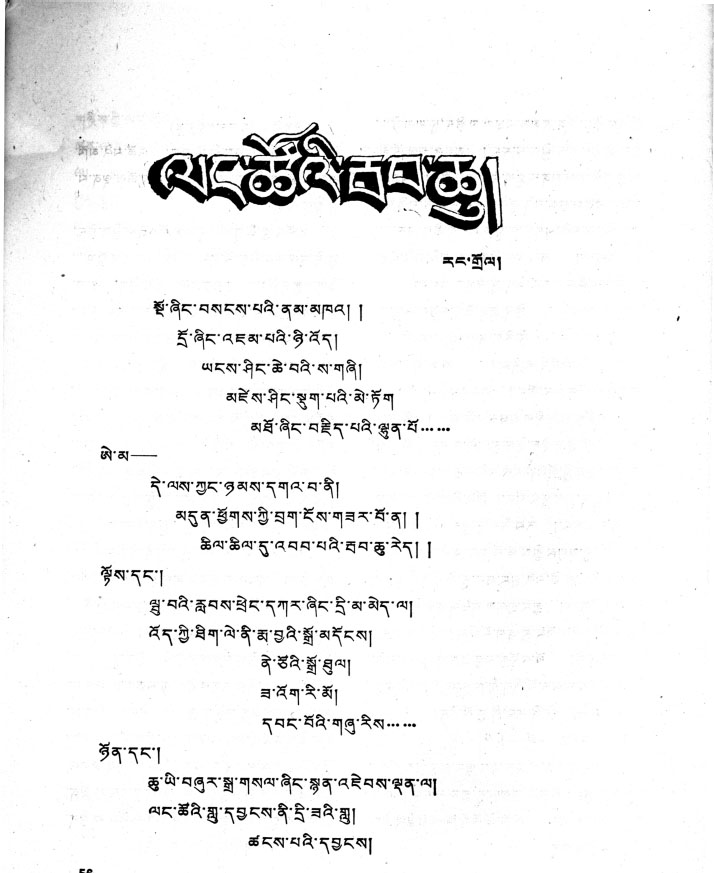
The first page of “Waterfall of Youth,” from its original publication in Light Rain in 1983
Truly,
Yesteryear with its glorious shining sun is no substitute for
today;
And how can yesterday with its salt-water quench the thirst of
today?
If the corpse of history, which is hard to locate,
Is bereft of the life-force appropriate for the times,
The pulse of development will never beat,
And the heart and blood of the avant-garde will never
flow,
Much less the march of progress.
[…]
Conservatism, traditionalism, superstition, laziness
Have no role whatsoever in our generation.
Backwardness, barbarism, darkness, reactionary thought,
Have no place at all in our age.[74]
“Waterfall of Youth” goes further than “The Narrow Path” in clarifying that what must be strived for is progress, and the waterfall, in its ceaseless and chaotic motion, is emblematic of this ideal. The waterfall may be rooted in Tibetan tradition—its source is “joined with the snows” and it is a “witness to history”—but its perpetual motion means that it “has the courage to gather new rivers” and its forward march cannot be halted.[75] The waterfall, and the river that precedes it, becomes the metaphorical rendering of a teleological vision of history. No matter the glories of the past, the only possibility is forward motion in time and the adoption of the new—be that literary innovation or the “youth of science” and the “maiden of technology.” “Waterfall” is also much clearer in stressing who is to be the carrier of this social progress: the youth, a logical conclusion to the view of history as a progressive temporal flow. This same concept of youth was central to Lu Xun and the May Fourth Movement in general;[76] in “Waterfall,” it occupies precisely the same role as a trope of social and historical progress.
Throughout “Waterfall” and Döndrup Gyel’s other poetry, the rhetoric of youth and progress is married to a vocabulary of “struggle” (’thab ’dzing) and “competition” (rtsal ’gran) grounded in a social-Darwinist conception of nations vying for position in the global order.[77] In the Chinese literary and intellectual tradition, the social reading of Darwin’s theories became key in a world of inter-national competition where the threat of extinction at the hands of more powerful nations was felt to be very real. James Pusey’s description of Lu Xun’s relationship with Darwinian evolutionary theory applies just as well to Döndrup Gyel: “He wrote, let us be clear, not to spread the gospel of evolution, but to save his people, to wake them up, to get them to change their ways, in thought and word and deed, to save themselves—from themselves.”[78] Beyond “Waterfall,” Chen Duxiu’s 陈独秀 (1879–1942) famous call to promote “Mr. Science” can be found throughout Döndrup Gyel’s work, in which a broader ideology of science—or scientism—played a key part. According to Pema Bhum, Döndrup Gyel and his friend Dawa lamented the lack of academic opportunities for Tibetans, in particular the fact that their sole path in university was Tibetan language and literature. It was vital, they felt, that science be taught in Tibetan.[79] As with his cultural critiques, Döndrup Gyel’s insistence on valuing tangible material (as opposed to purely spiritual or intellectual) progress through science and technology was adopted and furthered by numerous successors in the following decades.
While the most striking aspects of “Waterfall” are its literary innovation and its ideology of youth, anti-conservatism, and material and intellectual progress, we should not miss the significance of the manner in which all of this is centered around and filtered through a conception of the Tibetans as a nation. Ultimately, “Waterfall of Youth” represents a paradigm shift in this regard. The vision of the poem ranges across notions of shared history, language, culture, and race, with no mention of the shared religion that so often defines Tibetan identity. “Waterfall of Youth” offers us instead constructions such as “the youth of the Tibetan Land of Snows” (bod gangs can gyi gzhon nu rnams), “the new generation of the Tibetan Land of Snows” (bod gangs can gyi mi rabs gsar pa), “our nation” (rang re’i mi rigs), and “the youth of the Tibetan race” (bod rigs gzhon nu rnams). Ever since its publication, Tibetan readers and critics have overwhelmingly read the poem as national metaphor. The waterfall itself is seen by the critic Tsedrup as a symbol of Tibetan national (mi rigs) or racial (rigs rgyud) solidarity across all divisions, a declaration of the necessity for all “people from the land of snows” (gangs can pa rnams) to unite, regardless of different doctrines, of whether they are farmers or nomads.[80] His emphasis on unity is revealing and encapsulates what is in many ways at the heart of “Waterfall”: a call for cultural renewal and progress made specifically through a nationalist lens.
Döndrup Gyel in Beijing
That Döndrup Gyel’s literary interests so closely paralleled those of the May Fourth era does not come as such a surprise when we consider the cultural milieu in which he found himself during his creative years. Döndrup Gyel first went to Beijing in 1971, where he studied for three years at the Tibetan department of the Central Institute for Nationalities (krung dbyang mi rigs slob gling, Ch. Zhongyang minzu xueyuan 中央民族学院, hereafter CIN).[81] During this time, he also took trips to Wuhan, Changsha, and Shaoshan (birthplace of Mao Zedong 毛泽东, 1893–1976), primarily to study Chinese.[82] In 1978, he again left Qinghai for Beijing to take up a place as a research student at CIN. He graduated in 1981, but remained at CIN as a teacher until 1984, when he returned to Qinghai, where he lived until his death in 1985. It must be stressed, then, that Döndrup Gyel spent most of his adult life in the academic environment of Beijing: roughly, from the formative years of 18 to 22, and again from 25 to 31, before his death in Qinghai at the age of 32. It was during this time that most of his literary works—including his first book-length collection The Dawn of Unstilted Composition (published 1981), “The Narrow Path,” “Tulku,” “Waterfall of Youth,” and many others—were written and published.
Döndrup Gyel’s second stay in Beijing from 1978 to 1984 coincided with the intellectual and cultural renaissance that was taking place in the wake of the Cultural Revolution, a time when many of the profound issues surrounding nation, society, and civilization were being discussed with renewed urgency. The late 1970s witnessed the beginnings of this shift with the “Movement to Liberate Thinking” (sixiang jiefang yundong 思想解放运动), a campaign that began an official move away from the ideology of the Cultural Revolution and towards, among other things, a materialist scientism that situated science and technology as central determinants of social development.[83] In 1983, Wang Ruoshui 王若水 published an essay on the need for humanism in Marxism, sparking a “humanism fever.” Many more “fevers” (re 热) (culture fever, reading fever) would follow, signs of the more widespread cultural and intellectual trends that constituted a “New Enlightenment Movement” (xin qimeng yundong 新启蒙运动) in the 1980s.[84] Whether it was the cultural politics discussed by philosophers such as Li Zehou 李泽厚 or the “Marching Toward the Future” scientism of Jin Guantao 金观涛, these were developments that Jing Wang defines as “utopian”; that is, future-oriented debates about the course that should be taken by Chinese culture and society.[85] These movements continued after Döndrup Gyel left in 1984, and he missed some of their crescendos—most notably the student protests of 1989—but his years in Beijing overlapped to a significant extent with the inception and subsequent flourishing of a radically new cultural environment. This was a moment in Chinese history where, once more, “intellectuals rather than average citizens appeared to be the unequivocal spokespeople for the Chinese modern.”[86]
This central role of writers and thinkers in directing the nation—in other words the role that Döndrup Gyel adopted himself—was one of several features that have led scholars to define this era as a second May Fourth.[87] There were many ways in which this connection between the 1980s and May Fourth was raised. Intellectuals such as Li Zehou and Liu Zaifu 刘再复 invoked the May Fourth precedent in broad debates over the question of tradition and modernity, arguing that the revisiting of these themes was warranted because May Fourth thinkers had failed to resolve the problems they themselves had raised.[88] Others defended against the charge of a mere repetition of old discussions by insisting that the debates of the 1980s constituted a “higher level” return to May Fourth concerns.[89] However this return was interpreted, there was a consensus that that is indeed what it was: a renewed consideration of the problems of tradition, modernity, scientism, social development, and the role of intellectuals in resolving larger social and political issues.[90] It was in this way that the “New Enlightenment Movement” became “another ‘May Fourth,’”[91] that “culture fever” became May Fourth’s “contemporary counterpart.”[92]
The post-2000s Tibetan intellectuals who have followed in Döndrup Gyel’s footsteps have underscored these same connections. In Chökyong’s pioneering volume Rangdröl Research, he calls the broader environment of 1980s China a “second May Fourth” and equates the developments in Tibetan literature that were happening at the same time to the May Fourth Movement. [93] Shokjang (zhogs ljang), a progressive intellectual and essayist, likewise stresses the importance of Döndrup Gyel’s engagement with Chinese texts and the cultural-historical context of the 1980s, a time when young Chinese intellectuals had launched a “new culture movement” and “once again issued a call to awaken China from the sleep of ignorance.”[94] The Chinese Tibetologist Ma Lihua 马丽华 even managed to make this comparison without any reference to Döndrup Gyel, describing the Tibetan-language literature of the 1980s as “nothing less than a revolution, a ‘May Fourth’ new culture movement.”[95] For the Han Chinese intellectuals discussed above, the 1980s represented a return to long-discussed themes of Chinese literature, but in Tibet, this same period is conceived of as the very beginning of literary modernity. Thus, in effect, Tibetan readings of the 1980s as a second May Fourth forge a double link to modern Chinese literary traditions, as Tibetan literature is being situated within China’s post-Cultural Revolution literary renaissance, but since this period also constitutes the founding of a modern Tibetan literature itself, it is simultaneously seen as comparable to the original May Fourth movement.
As Döndrup Gyel was in Beijing between 1978 and 1984, it is widely held that he was influenced by the “new thinking” and “new viewpoints” being circulated in China’s capital at the time.[96] Tibetan critics see Döndrup Gyel’s association with new intellectual developments in 1980s China in many forms, particularly through his attachment to the dominant themes of “enlightenment” (blo ’byed) and “humanism” (mi chos ring lugs).[97] In a wide-ranging discussion on the anniversary of the author’s death, Jangkar (byang skar), another of the progressive essayists who have consciously built on Döndrup Gyel’s legacy, emphasizes that this was a pivotal time for Tibetan literary and intellectual culture, a moment of new possibilities created by new interactions. He even compares Döndrup Gyel’s immersion in this environment (and his subsequent return to Tibet) to Itō Hirobumi’s (1841–1909) and Yan Fu’s 严复 (1854–1921) education abroad in England, from which they brought back new knowledge to Japan and China, respectively.[98]
One of the most significant ways in which Döndrup Gyel drew from this environment was his exposure to new translated literature. As Hartley notes, translations of May Fourth texts into Tibetan in the 1980s and their publication in the newly emerging journals of the time resulted in Chinese literary discourse leaving a major mark on the beginnings of modern Tibetan literature.[99] The new wave of literary and academic translations into Chinese in the 1980s was one of the key factors that sparked the various “fevers” and cultural debates of the decade,[100] and Döndrup Gyel was inspired by these new possibilities just as much as his Chinese counterparts. It has been claimed that when Döndrup Gyel was at school in Qinghai in the mid- to late-1960s (i.e., during the Cultural Revolution), there was little to read besides translations of Mao and a handful of party documents.[101] After Döndrup Gyel moved to Beijing, this situation changed dramatically, and there can be little doubt that this was for him a period of exposure to a range of inspirational ideas and works of literature.
Trying to piece together a picture of Döndrup Gyel’s reading habits relies primarily on the recollections of his friends and colleagues, which are understandably sparse. Nevertheless, these recollections point to a diverse range of sources. Gurong Pündröl (dgu rong spun grol), Döndrup Gyel’s half-brother and a notable scholar of his work, recounts a meeting in 1984 when Döndrup Gyel was reading a Chinese translation of Rousseau’s Confessions.[102] Chökyong mentions a collection containing Mayakovsky (of whom it is said Döndrup Gyel was particularly fond), Sherlock Holmes stories, War and Peace, and The Hunchback of Notre Dame.[103] Texts such as these had not formed a part of the Tibetan literary spectrum prior to this period, and Döndrup Gyel’s exposure to them through translation no doubt played a role in the innovations of his own writing.
For Han Chinese intellectuals of the 1980s, translations of foreign literature and scholarship were a means to connect with new ideas and drive new cultural debates. This was also true for Döndrup Gyel, but at the same time, Chinese writing itself was equally “foreign,” and in that sense had the same effect as translated literature. His colleagues Gomé Dorjé Rinchen (sgo me rdo rje rin chen) and Sangdak recall that he often read Chinese literature in addition to foreign literature in Chinese translation, the latter citing two patriotic socialist poems in particular: “Returning to Yan’an” (Hui Yan’an 回延安) by He Jingzhi 贺敬之 (written in 1956), and “The Battle of Xisha” (Xisha zhi zhan 西沙之战) by Zhang Yongmei 张永枚 (written in 1974).[104] Chen Qingying 陈庆英, who studied with Döndrup Gyel at CIN, remembers that during that time he read magazines such as People’s Literature (Renmin wenxue 人民文学), Selected Stories (Xiaoshuo xuankan 小说选刊), and Qinghai Lake (Qinghai hu 青海湖).[105]
Though it is hard to say how deeply he was exposed to Lu Xun specifically, we know that Döndrup Gyel had read him, since he mentions Lu Xun’s work in his own essays.[106] Tibetan translations of “The True Story of Ah Q” (A Q zhengzhuan 阿Q正传) and “Diary of a Madman” (kuangren riji 狂人日记), Lu Xun’s landmark stories of cultural introspection and critique of the “national character,” were published in book form in 1979 and 1980, and likely would have been accessible to Döndrup Gyel, who was at CIN at the time.[107] But of course, Döndrup Gyel’s fluency in Chinese would have allowed him to read Lu Xun in the original, anyway. What we can say for certain is that Döndrup Gyel represents only the beginning of a prolonged engagement between Chinese and Tibetan literary traditions, one that became even more apparent with a subsequent generation of writers who made their debt to both Döndrup Gyel and May Fourth traditions explicit.[108]
Döndrup Gyel’s collected works contain further evidence of his reading habits. In addition to May Fourth writers such as Lu Xun and Mao Dun 茅盾 (1896–1981), his essays on literary composition cite an array of figures, including Balzac and Gorky, Mao Zedong, and the essayist Qin Mu 秦牧 (1919–1992).[109] The translations volume of his collected works furthermore features a number of Chinese literary texts that he rendered into Tibetan. There are two pieces by the Mongolian author Malqinhu (Malaqinfu 玛拉沁夫, b. 1930), an essay by the great Lao She 老舍(1899–1966), numerous praise poems from the “learn from Daqing” campaign, and two short stories by the science-fiction writer Tong Enzheng 童恩正(1935–1997).[110] But last of all, it must be stressed that his education at CIN also resulted in an extensive engagement with Tibetan literary and historical texts. In addition to his interest in Gendün Chöpel (dge ’dun chos ’phel, 1903–1951), Döndrup Gyel did much of his academic work at CIN on Tibetan history and composed renowned treatises on the Ramayana and the traditional oral poetry of gur, on which he wrote his master’s thesis.
In order to form a fuller picture of Döndrup Gyel’s work, we must appreciate the extent to which his education in Beijing and his entry into the intellectual field of 1980s China shaped his thinking. Given the fact that Döndrup Gyel’s writing has served as a cornerstone for the subsequent development of modern Tibetan literature, this is crucial not only for the question of how we approach his work, but how we approach the study of modern Tibetan literature in China as a whole. We may be able to extend this perspective even further if we broaden our horizons beyond Tibetan writing. Perhat Tursun and Tahir Hamut, two of the most renowned contemporary Uyghur-language writers, also attended CIN in the 1980s. There, both authors were exposed to the same cultural whirlwind, immersing themselves for the first time in “language and thinking outside of Uyghur traditions.”[111] They read Chinese translations of authors including Faulkner, Kafka, Joyce, Camus, Freud, Nietzsche, Dostoevsky, and Schopenhauer (as was the case with Tibetan, such texts were unavailable in Uyghur translation). Equipped with this knowledge, they crafted groundbreaking works of new literature in the Uyghur language, which inspired and provoked in equal measure (Perhat Tursun, much like Döndrup Gyel, found himself labeled a heretic by conservative Islamic scholars).[112] The similarities between their trajectories and Döndrup Gyel’s, moving from radical new experiences in the capital to a re-fashioning of literary traditions back home, prompt us to reflect on the manner in which potentially all “minority” language literatures in China have been impacted by their encounter with the hegemonic culture, as well as global cultures through translations into the hegemonic language of Chinese.
Conclusion
Of course, if Döndrup Gyel borrowed from May Fourth discourses of cultural critique, he still translated these influences into his own iteration of nationalist thought. One of the clearest ways in which he diverged from May Fourth iconoclasm is his preoccupation with the Tibetan Empire of the 7th to the 9th centuries. If we look at his six-volume collected works, we see that his scholarly writing accounts for a significant proportion of its total, and that essays on Tibetan history account for a significant proportion of that scholarly writing. His interest in the Tibetan Empire fits with his broader intellectual interests since it seemed to represent an era on which national identity could be based; this was a time when Tibet began to embrace Buddhism but was not yet defined by it, and a time of political, military, and cultural strength, when even the Tang capital of Chang’an was briefly occupied by Tibetan forces.
Like Gendün Chöpel, Döndrup Gyel took a particular interest in the documents on Tibetan history and culture that emerged from Dunhuang. With his colleague Chen Qingying at CIN, he translated into Tibetan sections of the Tang annals that dealt with the Tibetan empire,[113] and the historical cast of the period even crops up in his creative writing: his unfinished story “Exploring the Tombs of the Kings” (btsan po’i bang so myul ba’i gtam rgyud) centers around a university student who is fixated on the imperial era and dreams of meeting the renowned king Songtsen Gampo (srong btsan sgam po, 617–698).[114] His appraisal of these figures is invariably positive. In one essay on education in early Tibet, he lauds the intellectual capacities of Songtsen Gampo and Thönmi Sambhoṭa (thon mi sam+b+ho Ta, 7th c.), the minister traditionally credited with inventing the Tibetan script. Döndrup Gyel sees in these men a reflection of his own values: they were “scientific” innovators who “studied the speech and scripts of other nations (mi rigs)” then founded Tibetan grammar and script through cultural borrowing.[115]
Döndrup Gyel’s interest in the perceived glories of Tibetan history is one aspect of his nationalist discourse that is very much in keeping with the classic modus operandi of other nationalist intellectuals. This is what Renan called the “cult of ancestors,” the “heroic past, great men, glory” upon which unifying nationalist rhetoric is traditionally based,[116] or what Smith identifies as the “the presence and/or rediscovery of a distinctive ‘ethno-history,’” the return to “an idealized image of ‘what we were.’”[117] But it is also one way in which he is at odds with May Fourth discourse. For Lu Xun and many of his contemporaries, such glorification of the past was anathema, the refrain of the “national essence” (guocui 国粹) group who were a consistent target of Lu Xun’s attacks.[118] Döndrup Gyel’s selective lauding of the past reflects the celebratory side of his “national pride,” and certainly doesn’t chime with May Fourth “cultural masochism.”
However, as Drölma Gyatso pointed out in her 1990 essay, “national pride” was a two-sided coin: Döndrup Gyel’s relentless critiques of Tibetan “backwardness” were always central to his nationalist discourse. We cannot overlook or underestimate the radical nature of Döndrup Gyel’s project, and above all the striking narrative he produced of a benighted Tibetan nation, a narrative that had little to no precedent in Tibetan tradition.[119] In Tibet, a new generation of writers in the post-2000s have picked up on Döndrup Gyel’s work and have sought to push it further, inspired most of all by his radically progressive tendencies. Innovations in form and literary style were indeed a significant part of this, but as I have sought to demonstrate here, his work was most influential and provocative of all in terms of the new, self-critical discourse of nation that it offered to Tibetan readers.
As he constructed this discourse, Döndrup Gyel’s writing harked back to the debates of early modern China through the idiosyncratic ways in which he conceived of a nation responsible for its own suffering. This vision—the nation tied down by material and cultural backwardness and in need of radical reform—loomed large over the birth of modern Chinese literature, and at the beginnings of modern Tibetan literature, it was recreated with uncanny likeness. Döndrup Gyel’s writing is often seen as a fulcrum, a dramatic shift into Tibetan literary modernity. But the fact that this shift occurred within modern China represents an entirely unprecedented development in the history of Tibetan literature, and its significance must reshape our approach accordingly. Döndrup Gyel’s intellectual interests are in conversation with Lu Xun in particular, which is apparent when we consider the two authors’ shared concerns of literary innovation, cultural self-critique, national awakening, and generational renewal. But if there is one final comparison to be made between Lu Xun and Döndrup Gyel, it is that both writers left enduring and influential legacies, because Döndrup Gyel, more than any other Tibetan author, set the tone and dictated the parameters for how these topics would be addressed by those who followed him.
1. Don grub rgyal 2008, 2.
2. Lama Jabb 2015a, 59–84; Lin 2008. See also Virtanen 2014.
3. Willock 2021, 222–226.
4. Bdud lha rgyal 2011, 201.
5. The prominence of these pieces is also reflected in their various translations. “Waterfall of Youth” has been translated into English by Tsering Shakya (Dhondup Gyal 2000), Hartley (2017), and Cook (Rangdrol 2018). “The Narrow Path” has been translated into English by Stevenson and Lama Choedak T. Yuthok (Rang grol 1997, as “A Threadlike Path”) and Riga Shakya (Dhondup Gyal 2015, as “The Narrow Footpath”), French by Robin (Dondrupgyäl 2011), and German by Erhard (Dondrub Gyel 2009).
6. Stevenson 1997, 58; Shakya 2004, 183 and 191.
7. For her discussion of Döndrup Gyel, see Hladíková 2013, 95–105.
8. For a detailed description of the author’s life, see Pema Bhum 1995.
9. Photographs of the original note, as well as a Tibetan translation, are included in the second volume of Rangdröl Research. See Dgu rong spun grol 2011, 1–6.
10. Nyi gzhon et al 2010, 147; Sprel nag pa rig ’dzin grags ldan 2015, 150; Dgu rong spun grol 2014, 302.
11. Stoddard relays the “official version” that he had problems with alcohol and his marriage, as well as theories about his tense relationships both with other Tibetans and the Chinese authorities (Stoddard 1994, 827). Stevenson subscribes to the latter version, reporting that he heard Döndrup Gyel committed suicide when he received word of his imminent arrest (Stevenson 1997, 60). Pema Bhum’s biography of the author, a more comprehensive and likely well-informed source, discusses his “difficulties in his work and in society,” as well as his marital issues. Surveying the wide variety of rumors that circulated in Amdo about Döndrup Gyel’s death, Pema Bhum wisely concludes that these various accounts reflect “the attitude of the persons spreading them” (Pema Bhum 1995, 26–27).
12. Lu Xun 2005, 1:437–443; trans. Lu Xun 2009, 19.
13. Hladíková 2013, 103–104.
14. Smith 1991, 19–20.
15. Zhogs ljang 2014, 224; Me lce 2013, 194; Bde skyid ’tsho 2006, 2; Nyi gzhon et al 2010, 149, 164–165; Sangs rgyas rin chen 2010, 29. Hladíková also employs the phrase when discussing Döndrup Gyel’s poetry, noting the “intensity with which he seeks to awaken the ‘sleeping nation’” (Hladíková 2013).
16. Sun used the famous “loose sand” analogy in his “Three People’s Principles.” For an English translation, see de Bary and Lufrano 1999, 321.
17. Wimmer 2013, 69.
18. Zhogs ljang 2014, 190; Sprel nag pa rig ’dzin grags ldan 2015, 97.
19. Huang 2013, 3–13.
20. Lee 1987, 190.
21. Pema Bhum 1995, 26–27.
22. The text of this and another eulogy are included in Rang grol zhib ’jug: ’don thengs gnyis pa. See Sangs rgyas rin chen et al 2011, 238–255.
23. Pema Bhum 1995, 27–28.
24. Döndrup Gyel is known by several names. These include his pennames “Radio Victory” (rlung ’phrin rgyal) and “Self-Liberated” (rang grol). His name is also sometimes prefaced in scholarly writings by dpal, a courteous term for the deceased. For explanations of these and other titles, see Sprel nag pa rig ’dzin grags ldan 2015, 56–77.
25. For a detailed list of “Rangdröl research” from the 1980s through to the late 2000s, see Sprel nag pa rig ’dzin grags ldan 2015, 12–55. For another list of “Rangdröl research” in Tibetan, Chinese, and Western languages, see Chos skyong 2006, 26–38.
26. Quoted in Foster 2006, 231.
27. Chos skyong 2006, 38.
28. “National pride” has become a ubiquitous concept in Tibetan intellectual circles. As Lama Jabb points out, an ideological cornerstone of the poets who comprised the “Third Generation” was their self-declared rejection of Döndrup Gyel’s slogan (Lama Jabb 2015a, 138).
29. Tshe grub 2007, 28.
30. Don grub rgyal 1997, 1:151–152.
31. Sangs rgyas rin chen et al 2011, 251.
32. According to Chökyong, this is the first article to discuss Döndrup Gyel in terms of national pride (Chos skyong 2006, 18).
33. Sgrol ma rgya mtsho 1990, 52.
34. Though, in formal terms, the “I” of an essay might be assumed to be the author, the literary nature of “The Narrow Path” might make us cautious of such an assumption.
35. Don grub rgyal 1997, 6:1; trans. Rang grol 1997, 61.
36. Don grub rgyal 1997, 6:4. Most Tibetan scholars have read “The Narrow Path” as national metaphor. See Rmog ru don grub tshe ring 2003, 131; Sprel nag pa rig ’dzin grags ldan 2015, 181; Chos skyong 2006, 250.
37. Don grub rgyal 1997, 6:3; trans. adapted from Rang grol 1997, 62.
38. Don grub rgyal 1997, 6:4; trans. Rang grol 1997, 63.
39. Don grub rgyal 1997, 6:4–5; trans. adapted from Rang grol 1997, 63.
40. Bde skyid ’tsho 2006, 4–5.
41. Sprel nag pa rig ’dzin grags ldan 2015, 186–187.
42. Don grub rgyal 1997, 6:5; trans. adapted from Rang grol 1997, 63.
43. Don grub rgyal 1997, 6:6; trans. adapted from Rang grol 1997, 64.
44. Don grub rgyal 1997, 6:7. Nancy Lin has highlighted the importance of the wording in this final scene: that the narrator is involuntarily (rang dbang med par) compelled to go (spo dgos byung) towards the highway (Lin 2008, 105–6). This is not a choice he makes happily; it is rather forced upon him by circumstance—the failure of the narrow path to meet the needs of the present day.
45. Don grub rgyal 1997, 6:6.
46. Stevenson 1997, 58.
47. This is, however, a term still closely associated with Döndrup Gyel: it was in the title of his debut collection, The Dawn of Unstilted Composition (’bol rtsom zhogs pa’i skya rengs).
48. Pollard 2000, 19. Several of these Tibetan essayists are mentioned in this article. Their use of the zawen-essay is discussed in chapter five of my doctoral dissertation (Peacock 2020).
49. In 1983, the year before the publication of “The Narrow Path,” this theatrical vignette had also received renewed life in Beijing (where Döndrup Gyel lived at the time) when it was staged prior to performances of Gao Xingjian’s 高行健 high-profile play Bus Stop (Chezhan 车站) (Riley and Gissenwehrer 2001, 119–120).
50. Lu Xun 2005, 2:193–199.
51. Don grub rgyal 1997, 2:123.
52. Dgu rong spun grol 2011, 17–18; Pema Bhum 1995, 22; Pema Bhum 2008, 143; Kapstein 2002, 99; Hartley 2003, 226–228.
53. Tibetan critics have also argued that the story is not an attack on the tulku system, but, via Akhu Nyima, a critique of Tibetan cultural and social attitudes (Sprel nag pa rig ’dzin grags ldan 2015, 167–180; Deji Cao 2013, 10).
54. The borrowing of this plot device aside, “Tulku” could not be described as a work of “scar literature” due to its focus on the problems of religious revival (as opposed to the traumas of the Cultural Revolution). “Scar literature” did, however, play a role in Tibetan literature as a genre some years after its popularity in Chinese (see Shakya 2008, 75–76).
55. Don grub rgyal 1997, 2:133–134.
56. Don grub rgyal 1997, 2:154.
57. Pad ma ‘bum 2014, 360.
58. Kapstein 2002, 110.
59. Lama Jabb 2015b.
60. Lama Jabb 2015b, 232.
61. Hsia 1961, 533. See also Lee 2002, 142–143.
62. Lin 1972, 26–27.
63. Schwarcz 1986, 2.
64. Tsu 2005, 31, 231n18.
65. Foster 2006, 19–20.
66. Connor 1994, 75–76.
67. Lu Xun 2005, 1: 65–120.
68. Crespi 2017, 121.
69. This has been widely accepted among scholars of Tibetan literature, though Lobsang Yongdan has disputed the claim, pointing to Tibetan political poems published between 1949 and 1979 as well as translations of free-verse poetry into Tibetan during the Cultural Revolution (Blo bzang yon tan 2018).
70. Don grub rgyal 1997, 1:131; trans. adapted from Hartley 2017, 767.
71. Hartley 2017, 765.
72. Chos skyong 2006, 238; Me lce 2013, 7–8.
73. Blo bzang yon tan 2015.
74. Don grub rgyal 1997, 1:135–136; trans. Hartley 2017, 768.
75. Don grub rgyal 1997, 1:132–134.
76. See Song 2017.
77. Don grub rgyal 1997, 1:131, 136, 233, 212. The term “struggle” is a contentious one, since it also raises the specter of Mao-era struggle sessions. Döndrup Gyel’s critics have accused him of reproducing Maoist language (and ideology), and the term undoubtedly invokes multiple associations here and elsewhere in his work.
78. Pusey 1998, xi. In Döndrup Gyel’s case, we could argue that he actually aimed to do both, since he did try to spread the “gospel of evolution” in his 1982 essay “The Origin of the Tibetan Race and the Term ‘Tibet’” (Bod du ’gro ba mi’i rigs byung tshul dang bod ces pa’i tha snyad kyi ’byung khungs) (Don grub rgyal 1997, 3:195–198). Darwin and evolutionary theory also come up in his translation of the Chinese science-fiction writer Tong Enzheng’s 童恩正 story “The Magic Flute of the Snow Mountains” (Xueshan mo di 雪山魔笛, Tib. ’Dre ’bod rkang gling), which makes reference to Darwin’s The Origin of Species (Skye dngos kyi ’byung gzhi) and Huxley’s Man’s Place in Nature (Rang byung khams kyi mi’i go gnas) (Don grub rgyal 1997, 4:205-247). For a discussion of these connections, see Peacock 2021.
79. Pema Bhum 1995, 22.
80. Tshe grub 2010, 101.
81. The “institute” has since been renamed a “university” (Krung dbyang mi rigs slob grwa chen mo, Ch. Zhongyang minzu daxue 中央民族大学), and more recently still, it has been rebranded in English as “Minzu University of China.” As with the nearby “Renmin University of China” (People’s University), the change appears to be aimed at terms considered politically sensitive or outdated to a foreign audience (in both cases, the original Chinese names remain unchanged). The university continues to be a major center for Tibetan writers and scholars in the PRC.
82. Sprel nag pa rig ’dzin grags ldan 2015, 197.
83. Xu 2004, 185.
84. Xu 2004, 183; Davies 2017, 758–763.
85. Wang 1996, 40.
86. Wang 1996, 48.
87. Chen & Jin 1997, 130.
88. Wang 1996, 125.
89. Wang 1996, 52.
90. Wang 1996, 52; Xu 2004, 188.
91. Xu 2004, 183.
92. Wang 1996, 71.
93. Chos skyong 2006: 65, 175, 189.
94. Zhogs ljang 2014, 183–184.
95. Ma 1998, 58, 68. When Ma wrote her book, there were few Chinese translations of his work, which is likely the reason for her conspicuous omission of Döndrup Gyel.
96. Me lce 2013, 156-15–8; Zhogs ljang 2014, 183–184; Bdud lha rgyal 2014, 180–182.
97. Sgren po 2011; Bdud lha rgyal 2014, 166.
98. Nyi gzhon et al 2010, 197–198.
99. Hartley 2003, 173.
100. Davies 2017, 762.
101. Sprel nag pa rig ‘dzin grags ldan 2015, 102–103.
102. Dgu rong spun grol 2014, 298–299.
103. Chos skyong 2006, 62, 75, 121–122.
104. Sgo me rdo rje rin chen 2007; Gsang bdag 2017. Though he makes the point in order to question the originality of Döndrup Gyel’s writing, Lobsang Yongdan has also written about the connections between Döndrup Gyel’s work and Chinese poetry (Blo bzang yon tan 2015; Blo bzang yon tan 2018).
105. Chos skyong 2006, 62.
106. See, for example, Don grub rgyal 1997, 3:167–168, Don grub rgyal 1997, 6:96–98.
107. Translations of Lu Xun’s work into Tibetan continued to appear in major journals such as Bod kyi rtsom rig sgyu rtsal (Tibetan Art and Literature) throughout the 1980s. The essays and prose pieces “The Old Tune Is Finished,” “Teachers,” and “Snow” were published in the journal in 1986, 1987, and 1988, respectively.
108. I discuss these writers and their May Fourth connections extensively in chapter five of my doctoral dissertation (Peacock 2020). See also Hartley 2002 and Wu 2013.
109. Don grub rgyal 1997, 3:163–167; Don grub rgyal 1997, 6:89–125.
110. For a detailed discussion of the links between Tong’s story and Döndrup Gyel’s intellectual interests, see Peacock 2021.
111. Perhat Tursun 2022, xiii.
112. Allen-Ebrahimian 2015; Byler 2016; Perhat Tursun 2022, xiii–xiv.
113. Don grub rgyal 1997, 4:273–489. Nicole Willock highlights how both were students of Dungkar Rinpoché, who was particularly responsible for developing this field of study (Willock 2021, 180–181).
114. Don grub rgyal 1997, 2:352–397.
115. Don grub rgyal 1997, 3:54, 63.
116. Renan 2018, 261.
117. Smith 1991, 126, 140.
118. As Foster argues, Lu Xun “saw the ‘national essence’ as the negative national character” (Foster 2006, 22)—in other words, Lu Xun’s critique of the national character was an inversion of the positive cultural traits the national essence scholars believed China had been endowed with by history.
119. A crucial question yet to be properly reckoned with in Döndrup Gyel studies is his relationship to socialist and Maoist thought, a topic that has perhaps been avoided due to its sensitivity. One notable exception is Lobsang Yongdan, who has broached the subject in his critiques (Blo bzang yon tan 2015; Blo bzang yon tan 2018).